August 4, 2005 at 2:29 p.m.
Wild horses up for adoption
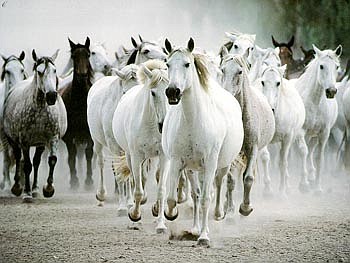
Wild horses up for adoption
The U.S. Department of Interior, Bureau of Land Management (BLM), is responsible for managing, protecting and controlling the wild horse population in the U.S.
One method the bureau uses for managing the herds is to hold wild horse adoption events throughout the country. Next weekend, BLM will hold an adoption in Lindstrom – its first-ever wild horse adoption in Minnesota.
The event will be held August 6-7 at Oasis Equestrian Center, under the watch of owner Cathie Lunzer. The Milwaukee BLM field office is organizing the event.
Jim Boylan, with the BLM in Milwaukee, said around 70-80 animals will be brought for adoption. One trailer will be all mixed yearlings and the other will be a mix of studs, mares and geldings.
None of the horses are older than five years and all will come with records of vaccinations, worming and negative Coggins test results.
Wild horse adoption is not something people can enter into lightly, as the BLM explains on its Web site. The horses are not used to human contact; it could take several months of working every day just to get a wild horse ready to take on a rider.
Lunzer said this will be her first experience with wild horse adoption. When she noticed on the Internet that the Bureau was looking for a facility close to the Twin Cities to host a wild horse adoption, she gave them a call.
Their site requirements for hosting the adoption fit with Oasis Equestrian Center and a date was chosen.
Lunzer said she will be on site during the weekend, but isn’t sure how much she will be involved.
“They hired some of my workers to do security and they are renting the facilities to use,” she said.
Lunzer said she appreciates what the BLM is doing with this program to save wild horses.
The adoption weekend will start with public viewing of the animals Friday from 1 to 5 p.m. The adoption sessions will be Saturday from 8 a.m. to 5 pm. and Sunday from 8 a.m. to noon.
The unique aspect about the adoption event, Boylan said, is that it will be run as a lottery among attendees.
Potential owners who have filled out an application and are approved to adopt the wild horses will be assigned a number. Saturday morning, those numbers will then be randomly drawn out of a hat. When a number is drawn, the applicant will then choose a horse to adopt from the remaining horses.
After the lottery is over, Boylan said, the horses will be available on a first-come, first-served basis.
Some of the horses come this weekend directly from rangelands in the Western U.S., while others will arrive from a BLM holding facility in Kearney, Nebraska. On its Web site, the BLM explains that wild horses are gathered from states such as Arizona, Colorado, Montana, New Mexico and Utah.
While it is billed as a wild horse and burro adoption, Boylan said it doesn’t look like any burros will be available for the Lindstrom event.
The process of adopting a wild horse is involved. People are required to fill out a detailed application form, which includes information about themselves and their facilities.
The facility requirements include a minimum of 400 square feet for each animal adopted.
Horses over 18 months of age must be kept in a corral with a fence at least six feet high and a two-sided shelter from inclement weather must also be provided.
They also sign a maintenance agreement that states ownership of the wild horse remains with the federal government for the first year after adoption. The new owners pay a $125 adoption fee as well.
Once the first year is up, owners can then apply for a certificate of title to own the horse. The BLM ensures that during that time, the owner has not mistreated the animal and still has it in their possession.
Owners must provide a signed statement from a qualified official, such as their veterinarian, stating they have provided care for the animal.“We do a follow up with those people afterward as well,” Boylan said.
Before the lottery begins Saturday morning, Boylan will review the requirements for adoption with attendees. “We let them know that law enforcement is backing us in case of any trouble with the event or adoptions,” Boylan said.
This is done to ensure that everyone coming to the adoption is committed to owning a wild horse. “We want to make sure people have the space and really want to do this,” Boylan said.
BLM staff will also inspect trailers to ensure the animal will be adequately transported the days of the adoption.
Wild horses have been federally protected since the passage of the Wild Free-Roaming Horses and Burros Act of 1971, signed into law by President Richard Nixon.
In 1978, the Public Rangelands Improvement Act was adopted, stating that the government had the authority to remove excess wild free-roaming horses and burros which pose a threat to themselves and their habitat.
Since the BLM started wild horse and burro adoptions, more than 205,000 animals have been adopted.
Application forms and more information about the Bureau of Land Management’s program are available at the Web site, www.doi.gov/horse/.
Oasis Equestrian Center is located on CR 9, one-and-a-half miles north of CR 20.

Comments:
Commenting has been disabled for this item.