February 17, 2005 at 7:56 a.m.
North Branch mayor encouraged by congressman’s efforts on bridge project
North Branch mayor encouraged by congressman’s efforts on bridge project
The City of North Branch has been working to obtain funding for the TH 95 Bridge Project since 1997. Once funding is available, the $12.5 million project could be completed within a three-year time frame. The project will reduce congestion within the city and will also provide a safe link across I-35 for pedestrians and bicyclists.
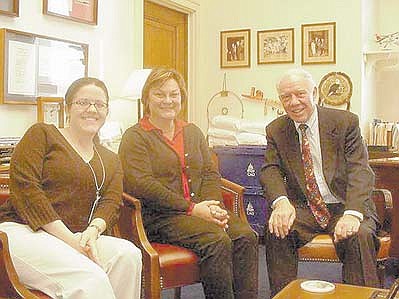
Mayor Karsky met with Congressman Oberstar and members of his staff to follow-up on the status of federal funding for the bridge. In response to this meeting, Mayor Karsky noted “I felt very encouraged by our meeting and the commitment of Representative Oberstar to pursue funding for the North Branch bridge project. I want the residents of North Branch to know that we are continuing to work towards getting the bridge project completed. The back up of traffic on the bridge is the number one complaint I receive from people. Completion of the bridge expansion is still the city’s number one goal.”
A six-year highway and transit funding bill (H.R. 3) that would guarantee $283.9 billion through 2009 was officially introduced in the U.S. House of Representatives February 9, 2005. The bipartisan legislation, the Transportation Equity Act: A Legacy For Users (TEA-LU), was introduced by Congressman James L. Oberstar, Ranking Democrat on the House Transportation and Infrastructure Committee, Congressman Don Young (R-Alaska), Chairman of the Transportation and Infrastructure Committee, and other members of the committee.
"The reauthorization of TEA-21 is now more than a year overdue," said Oberstar. "Last year, we were unable to reach consensus between our committee, the leadership of the House, the Senate, and the Administration. We cannot afford to put this action off any longer. We need to move this bill quickly and get it through conference by the end of May, when the current authorization extension expires."
TEA-LU re-authorizes the federal highway, public transportation, highway safety, and motor carrier safety programs for six years, from fiscal years 2004 through 2009. The legislation provides a total of $283.9 billion in guaranteed funding––a 42 percent increase over the guaranteed funding for TEA-21 (1998-2003).
"This bill will provide the investment necessary to begin to improve our nation’s highway and transit infrastructure," said Oberstar. "Our country’s economic strength, its ability to create jobs and improve business productivity, and maintain a safe, efficient, and secure transportation system are all dependent upon increasing our investment in its infrastructure."
In addition to protecting existing U.S. jobs in the transportation sector and related industries, millions of new jobs will be created by the infrastructure funding increases in TEA-LU. This legislation grows highway obligation authority from $34.4 billion in 2004 to $41 billion in 2009; public transportation funding grows from $7.3 billion in 2004 to $10.3 billion in 2009. TEA-LU provides $52.35 billion for transit programs, all guaranteed, which is a 51 percent increase in guaranteed funding. TEA-21 authorized $41 billion for transit programs, of which $36 billion was guaranteed funding.
"The increased investment is necessary to overcome the challenges of increased congestion, deteriorating infrastructure and the growing number of deaths and injuries on our nation’s roads. More than 42,000 Americans are killed and 2.9 million are seriously injured each year on the nation’s highways. In addition to the enormous personal toll of these accidents, the economic cost is a staggering $231 billion a year." Oberstar said. "Highway accidents continue to be a major public health problem in the U.S."
The same new highway programs authorized by the House last year are included in this legislation to improve congestion and move freight more efficiently. The bill authorizes a new $6 billion "Projects of National and Regional Significance" program to help states pay for high-cost highway projects that have significant national or regional benefits. The bill also increases the percentage of formula funding for public transportation in rural areas (towns of less than 50,000 population). Total six-year funding for rural public transportation increases by 60 percent, going from $1.25 billion in TEA-21 to $2 billion in TEA-LU.


Comments:
Commenting has been disabled for this item.