July 7, 2005 at 7:16 a.m.
County’s Farm Family of the Year noteworthy for tireless community relation-building
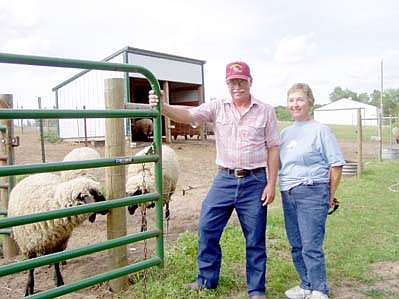
County’s Farm Family of the Year noteworthy for tireless community relation-building
The industry recognition, awarded by cooperating units within the University, (the Colleges of Agricultural, Food and Environmental Sciences, Veterinary Medicine, the Extension Service and the Minnesota Agricultural Experiment Station) is not a competitive event. Rather, Farm Families of the Year are an exclusive group of 60 families from throughout Minnesota who are selected by local peers as exemplary families in agricultural production who demonstrate a commitment to enhancing and supporting agriculture.
Extension personnel has been reduced in Chisago County and the County Extension Committee was made aware at its quarterly meeting in January that unless volunteers coordinated the program, it would be discontinued in this county. Commissioner Lynn Schultz, who represents the County Board on the Extension Committee, volunteered to do the work required to continue the recognition program. After obtaining the criteria and applications from the University, she arranged meetings with former farm families to nominate an area producer to the university selection committee.
Foster and Karen Mooney stood out among the applicants as area producers who have an ongoing relationship in their community, with the university and who demonstrate innovative techniques in their farming operation.
They will be recognized for their efforts by the Chisago County Extension Committee at the Chisago County Fair in July and by the University of Minnesota at Farmfest 2005 in August.
In the mid-1970's, with college degrees in hand, Foster and Karen began looking for land to farm. The urban farmland that Foster was raised on in western Hennepin County was priced out of range for production by 1975. With their belief in sustainable farming and that food should be produced close to its consumers, purchasing a part of the farm that Karen grew up on next to the banks of the Sunrise River and adjacent to the Carlos Avery Wildlife Management Area in Chisago County was the answer. Several neighbors to Mooney’s 120 secluded acres of Anoka Sand Plain are family members. “Jewel Lane Farm” is the direct result of two 4-H projects that turned into a career, Foster and Karen wrote in their application. In 1976 Foster and Karen started farming with a small flock of registered Hampshire ewes and raising cucumbers under contract for a regional pickle factory. Our cucumber experience taught us that if we were to be successful in small scale agricultural production we could not be selling our produce at wholesale prices, they added for the explanation as to how they have determined their course of production and marketing.
Since then the Mooneys have direct marketed their sheep. Most of the farm’s 20 vegetable items are sold at the Jewel Lane Farm produce stand in Stacy and the Lindstrom Farmer’s Market. Foster and Karen enjoy direct contact with their customers, evidenced by comments from customers who purchase from them either at their farm or at their vegetable stands.
Raising sheep is a popular aspect of small sustainable agricultural enterprises such as the Mooney farm, even though the United States is not among the top 10 producers of sheep worldwide, nor is Minnesota among the top 10 states in sheep production. “Raising sheep is a good fit with vegetable production as far as balancing the work load throughout the year,” Foster and Karen explained. March lambing is a busy time of year, then comes soil preparation, planting, harvesting and marketing vegetables through October. “And of course, there is the opportunity to build up the organic matter in the soil with sheep manure,” Foster added.
Foster is modestly proud of the improvement he has seen in the soil structure on his farm by resting some acreage each year and amending the soil with sheep manure.
“Things just seem to work out,” Foster laughed. Typically early August is their busiest time of year and the Mooneys have never been able to get away to attend Farmfest, the three-day annual agricultural event held in out state Minnesota at which the university honors its farm families. “This year, with the long cold spring and late, heavy rains, our crops will be late, and we will be able to attend the event,” he added.
Foster and Karen are professionally involved in both the animal and horticultural aspects of their enterprise. Their association with the University of Minnesota School of Veterinary Medicine and U of M plant data collection projects is primarily a result of their memberships in numerous professional organizations, Karen said.
A member of the Minnesota Hampshire Sheep Association, Minnesota Lamb and Wool Producers Inc., Chisago County Agricultural Society and the Farm Bureau, Foster spoke enthusiastically of the DNA testing program in which he has enrolled his flock in a proactive effort maintain lamb’s reputation as a safe meat.
Hampshires are noted for their rapid growth and efficient feed conversion. Jewel Lane Farm markets their sheep as show wethers for 4-H and FFA, breeding stock to commercial producers and freezer lamb to their established customer base of specialty meat consumers. Their animals are generally spoken for a year in advance of production.
Although Hampshire wool is marketable, it is not profitable to sell on a small scale, so Karen uses the shearing as an innovative mulch on the landscaping surrounding their home.
Foster maintains the flock at 40 ewes, keeping four or five of the best female lambs back for his own breeding stock. The top 10 lambs of each crop are sold to commercial growers and as show stock. The rest are processed into meat. This year Jewel Lane Farm accomplished the difficult goal of raising 100 percent of the lambs that were born.
On the horticultural side of the Mooney farm operation, Foster also serves on the Board of the Minnesota Fruit and Vegetable Growers Association. “Many members of the growers association head south for the winter, so it is convenient for us to be the winter contact for vegetable stand public relations,” Foster explained while Karen fielded a phone call from a potential farmer’s market vendor during the interview. That part of their public relations responsibility is picked up by other members as the growing season progresses and they get busy with outdoor farm work, Foster said.
Sustainable farmers usually use numerous innovative practices in their operation, and Jewel Lane Farm is no exception to this course. Some of the integrated pest management (IPM) practices of Jewel Lane Farm were featured in the September 2002 Minnesota Department of Agriculture publication, A Bountiful Harvest. Among other best practice methods described in that article, Mooney’s technique of farming under black plastic was described as beneficial to the environment because of the reduced need to use chemical pest control and irrigation.
The Mooneys use a specialized machine to lay black plastic directly on the soil. Driplines run under the plastic for irrigation. Foster is not entirely opposed to chemical pest control, but as he stated in the MDA article, spraying is the only farm chore he dislikes, and using black plastic mulch greatly reduces the chemicals he needs to handle and put on his land to achieve the quality produce direct purchasers expect.
“We grow the Great Eight,” Foster explained, “that is, corn, tomatoes, cucumbers, zucchini, potatoes, onions, pumpkin and squash.” Additionally, Karen experiments with new items in response to market trends she sees developing or customer requests. This year Jewel Lane Farm will bring garlic, cilantro, basil and gourds among other items to the vegetable stand.
The garlic plot is growing well, over a foot tall and already producing seed, Karen explained on the farm tour. After studying garlic growing on the Internet over the winter, she said she is now learning even more from one of her customers. “When you think you have learned it all is when you really start to learn,” Foster added as he and Karen sat down in front of their garlic plot for a photo.
Foster spoke for both himself and Karen in response to the question as to what their goals are for Jewel Lane Farm. “We have determined our threshold of production, and we are comfortable with it. Maybe I should have higher expectations,” he wondered aloud to Karen, “but we are living our dream.” Karen smiled and nodded in agreement.
Foster and Karen’s plans for the coming year are to continue promoting sustainable agriculture just as they have every year since they started farming in Chisago County in 1976. In other words, they will do an exemplary job of representing Chisago County’s farm families.

Comments:
Commenting has been disabled for this item.