March 17, 2005 at 9:14 a.m.
Spaghetti and glue become lesson in bridge-building at CLHS
Spaghetti and glue become lesson in bridge-building at CLHS
A three-week lesson in bridge engineering and the dynamics of physics involved in the working of bridges came to an abrupt, sometimes disappointing end for students as they watched their creations crumble in front of their eyes.
The assignment for students was to create a bridge that would hold the most weight compared to its own weight, known as the strength ratio.
Students in Saueressig's class had three weeks to come up with a design and create their bridge masterpieces out of uncooked spaghetti noodles and Elmer’s glue.
Dimensions of the bridge had to be specific, otherwise points were deducted for that portion of the project.
The students were required to use 16 ounces of spaghetti and four ounces of glue, for a total weight of no more than 20 ounces (1.2 pounds) on their bridges.
The bridges had to be at least 50 inches in length but no longer than 55 inches, and at least eight centimeters wide but no more than 12 centimeters.
Students could work alone on the project or with a partner. They started by researching real bridges and what they needed to build a strong bridge.
What most of them discovered along the way was that bridges needed one component to be strong. Saueressig asked the fourth period class members what they found it to be. “Triangles – they have to have triangles,” the students answered.
The different bridge creations that were brought into class Friday varied widely. Some resembled old-fashioned covered bridges, while others were highly arched like the Golden Gate bridge.
Students said there were several challenges in working on the bridge project.
“The hardest part was just coming up with a design,” one girl said. “It was hard to hold it while it dried,” another said.
Another bridge fell apart while being assembled and the student was forced to start all over the night before.
Senior Stephanie Kling said it took her about four evenings of work to complete her bridge, with a little help from her dad. She modeled her bridge after the basic design of a bridge in Chicago.
“I hope it will hold a lot,” she said. “If it holds a certain amount of weight that’s what the points are based on,” she said.
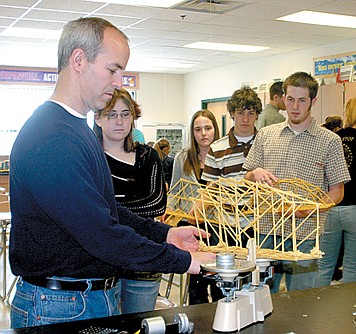
One by one, the students brought their creations to the scale where Saueressig weighed and measured each bridge. Points were deducted for any bridge not fitting into the design criteria.
Of course, there is always a rebel in the class. “We had one bridge made with linguini,” Saueressig said. “I have no idea why.” One healthy version of the spaghetti bridge in the fourth period class was made with whole wheat pasta, giving it a dark brown appearance.
Before their bridge was officially weighed, Sarah Boettner and Amber Pearl were busy cutting the tall point off their pyramid-style bridge, knowing it was way past the weight limit.
The two girls worked with a pliers as pieces of spaghetti noodles fell, trying to estimate how much to cut off their bridge while maintaining its structural integrity.
When the weigh-ins came, their bridge was 1.48 pounds, still over the 1.2-pound weight limit. Saueressig told them he would have to deduct 10 points from that portion of the project, but they didn’t mind. “We left it that way because we were afraid it would be too weak,” they said.
None of the students ventured a guess as to how much weight their bridges would hold, but they knew it was an important part of their overall grade on the project.
Each bridge was designed with room for a small wooden block with a hook to be fitted into it or on top. The block and hook then supported an empty five-gallon bucket.
Scoop by scoop, Saueressig slowly poured sand into the bucket to see how much weight the bridges would hold. Some bridges shattered after a few scoops, while others nearly drained the supply of sand before coming apart. Saueressig said he would stop and wait anytime he heard cracking from the bridge or the bucket started to sway. The cracking almost inevitably led to a broken bridge before another grain of sand was added.
The best designed bridges, Saueressig explained, were the ones that didn’t collapse, but simply dropped the wood and hook out the bottom while staying intact. These bridges were then honored on the “shelf of fame” in Saueressig’s classroom, where they will be displayed on top of the cabinets.
As the bridges were tested, Saueressig said he was very impressed with the bridges from this particular class. Most of the bridges turned in strength ratios of more than 20, which was high, he said. “Anything over 12 is good,” Saueressig said. A strength ratio of 20 means the bridge can withstand 20 times its own weight.
The highest strength ratio in the class was 34, recorded by the bridge constructed by Trevor Johnson. Boettner and Pearl were just hopeful their bridge would withstand holding up the empty bucket.
As they watched, Saueressig poured several scoops into the bucket before the bridge collapsed. The overall strength ratio was a 22, giving them 50 out of 50 points on that portion of the project.
In the end, 15 out of 21 bridges in the class earned a strength ratio of 18 or higher to garner the maximum number of points in strength. “I think it was the best class of the day,” Saueressig said.
The day was turned into a little party to recognize the hard work put into the bridges, as the students snacked on chips, ice cream and pop.
Along with constructing the bridge, the students were required to research and write a paper on actual bridges and the specific bridge design they modeled their spaghetti creation after. The paper also included any problems they faced during construction and how they solved them
Saueressig said it is always a fun project for the juniors and seniors in his physics classes. The students complete two major projects during the semester, which account for 20 percent of their overall grade.

Comments:
Commenting has been disabled for this item.