November 17, 2005 at 6:20 a.m.
Trails effort gets a boost with meeting in Chisago City
Trails effort gets a boost with meeting in Chisago City
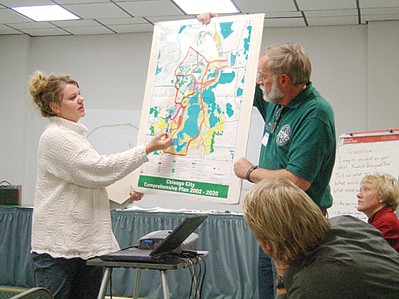
The only major trail accomplished around these parts has been the Sunrise Prairie Trail project, which opened in 1998. For a group of trail enthusiasts, many of whom who pushed for the Sunrise Prairie Trail, the time has come to reactivate the movement. A host of local officials and citizens got together in Chisago City November 9 to do just that.
They reviewed where the plan is at; what’s due to happen near term and how to boost efforts to make the most feasible projects happen.
The host city for the meeting-- Chisago City-- probably has the most walking, biking trails of all areas represented at last week’s meeting. Doris Zacho, parks coordinator, said that’s because the city council and staff are supportive of the trails philosophy and the city’s been pushing trail development as a condition of housing plat approvals.
Zacho mentioned priority projects in Chisago City will be a trail connection to the new library and the construction of the trail stub alongside Brink’s and Subway, connecting the North Avenue biking lane to the south side of the highway Stinson Ave. segment.
Chisago City Council member Larry Parker and Mayor Chris DuBose attended this session, with planner Courtney Weikert and Zacho.
Shafer’s mayor Heather Rosa attended, County Commissioner Ben Montzka was there. County Public Health staff member Pat Henton attended.
Several citizens active in the trails effort were also on-hand and Holly Larson, National Park Service, Rivers & Trails Program, moderated.
Dan Collins with the Minnesota Dept. of Natural Resources and a MNDOT rep, Mary Jackson, also spoke.
County Parks Director Laird Mork said the biggest factors in accomplishing a trail system right now are individual city cooperation and public awareness ie: lobbying.
He described the need to build consensus and get cities cooperatively talking about trails systems. This meeting is a step in the right direction, he stressed.
Mork said the way the county’s urban centers are expanding out it’s imperative that city officials make plans for where trails will be and get segments built into developments or collect fees as a condition of platting-- or there won’t be land and right-of-way to do trails in the future.
Joe Sausen, Chisago County Parks & Trails Foundation, added, “We are doing this for the future.”
He pointed out his 20-something daughter in the audience was about 10-years-old when he and fellow enthusiasts created the foundation in 1993.
Sausen noted that nobody in the room would allow a gradeschooler to ride a bike on busy local roads to get to a grocery store or even a friend’s house.
Highway 8 is the main artery between many locations, and an alternative to that route is a necessity, he said.
Larson shared research into active lifestyles versus obesity in youngsters. A number of people in the audience said biking and rollerblading are cheap, fun family activities and that’s why they are advocating trails.
The park service representative also had statistics on short-trips with vehicles and how a trail system could make those errands more healthy, reduce reliance on fuel, while keeping vehicles off the road.
Trails also keep bikes and pedestrians at a distance from motorized vehicles and lessen the potential for accidents.
There was information on the economic benefits of trail visitors who spend money and how trails promote towns.
MNDOT spokesperson Jackson shared some information about the highway concept design through Lindstrom. (An Open House for public comment is Monday, Nov. 21, at Lindstrom City Hall.)
She noted there’s also new money coming through a Congressional initiative “Safe Routes to Schools.” Minnesota is earmarked for $9.5 million over the next four years.
“Current thinking is any trail within two miles of a school would be eligible.” Details are being worked out because it’s a new program and a Task Force report is due March 2006, so monies won’t be distributed before then. Kristie Billiar, MNDOT Office of Transit, is the contact.
The Metropolitan Council is also putting together a greater metro trails system database so state transportation officials can consider trail locations in planning. Any government unit can submit information on local trails, both existing and planned, to the Met Council.
Collins, from the Minnesota DNR, said basically the DNR role is to make connections on a regional scale, but he still wanted to come learn about the county system and spend time with “kindred spirits.”
Collins mentioned the Gateway Trail out of the east metro is slowly “advancing to William O’Brien State Park” south of Chisago County, but the connection from O’Brien to Interstate Park or even Wild River is a ways-off.
What can you do?
~ Let your state, county and local elected officials know you want trails. Don’t be afraid to ask for a system to accommodate your interests...snowmobiles, horses, etc.
~ Join the non-profit Parks & Trails Foundation. (See form.)
The group usually meets in North Branch the third Thursday of each month, but they don’t meet in December. Make a New Year resolution to get active in 2006.
~ If you have property within or next to a trail corridor learn about what the plans are.


Comments:
Commenting has been disabled for this item.