August 31, 2006 at 7:27 a.m.
Healthy changes being made in district after adoption of new wellness policy
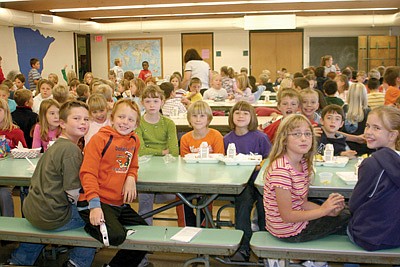
Healthy changes being made in district after adoption of new wellness policy
Federal law requires all school districts participating in federally funded meal programs to establish a wellness policy by the beginning of the 2006-07 school year. Chisago Lakes completed its wellness policy at the end of the 2005-06 school year after receiving input from a wellness committee, food service staff and administrators.
The wellness policy includes nutrition guildelines for food and beverages, nutrition education, physical activity goals, guidelines for communicating with parents and implementing timelines for changes.
One of the major changes that students will notice at the middle school and high school level is the elimination of pop from vending machines and the decreased selection of high calorie and fat selections in the ala carte lines – namely, Little Debbie snack cakes.
District Food Services Director Judy Caroon said students won’t see the snack cakes and similar items eliminated altogether, but has introduced healthier choices.
“One complaint we receive often is about the choices in the snack shop and ala carte lines,” she said.
At the middle school, the extra large cookies will probably be phased out over time, but healthy offerings are already available in the ala carte line, including nachos and cheese and baked potato chips.
High school students can buy candy bars, something Caroon would like to phase out. Other ala carte items will remain, however, such as ice cream and fruit snacks. Pop is already being pulled out of the vending machines at the high school, a voluntary move by the big pop manufacturers.
CLHS Principal Dave Ertl said the pop choices will be phased out over three years, with items like juices, Gatorade and more non-carbonated offerings such as milk drinks replacing the pop. Ertl met with the district’s beverage vendors this summer to ensure that some changes would be in place before the start of this school year.
The concern, he said, is that students will simply bring pop and other less nutritious beverages from home.
The snack vending machines will be offering fewer candy bars and high fat choices and more baked chips, health bars and pretzels as well, Ertl noted.
Students won’t see big changes in the breakfasts and lunches served at the schools. The meals are already made up of balanced offerings throughout the week.
Caroon said food service was proactive in working toward healthier choices in the last few years. Last year, for example, the district switched to whole grain breads. This year, a whole grain dinner roll will be added.
The frequency of desserts being offered in all the schools has already been reduced, with cookies being the dessert of choice.
“We still need to serve 12 bread items during the week, so sometimes that one-half serving needs to come from cookies,” Caroon said.
She said the food service program won’t need to make a lot of changes. At the high school, for instance, the alternative line is already full of healthy choices.
“It’s a lot of salads, wraps, yogurt, fruit cups and chicken sandwiches,” Caroon said. “The idea there was to offer something for the kids who normally aren’t eating hot lunch.”
They will also try introducing new fruits and vegetables at the schools, but nutrition needs to go farther than food service, Caroon feels.
“The changes need to be district-wide,” she said.
She is hopeful that teachers can focus on providing different incentives for academic goals than the typical pop or sweets. Caroon would also like to bring cook managers or even district produce suppliers into the schools to speak with students about nutrition.
Superintendent Mike McLoughlin was also a big part of completing the wellness policy, working closely with the wellness committee.
He said the committee began meeting in November 2005 and was comprised of students, parents and staff. They first worked off a template for a wellness policy provided by the Minnesota School Board Association, but fine-tuned the policy through worksheet goals.
Among its goals is recess before lunch – something advocated by Caroon. The biggest obstacle is scheduling, however and trying to get elementary principals on board, she said.
The idea is that if elementary-age children have recess before lunch, they will spend more time eating their lunch slowly – and eating more foods on their tray, instead of rushing to get out to the playground.
The group also talked about possibly restricting birthday treats brought from home to share with the class. Inevitably, these are sweets – cookies, cupcakes, etc.
That line of thought ties in with communicating to parents as well, to understand the importance of nutrition and the part it plays in childhood obesity.
The group also looked at physical activity guidelines. Currently, students in 1st-8th grades have physical education class at least twice a week. In high school, only freshmen and sophomores are required to take a phyed class, and they only need one class each year. Juniors and seniors take phyed as electives only.
McLoughlin said it’s something the district will look at in all the schools. “Is there enough recess and phyed time?” he said. “Can we encourage walking programs during the day? I don’t feel like there’s enough activity, but then what would go away?”
Changes won’t happen overnight, he said, and that’s how they want it.
“We want it well thought out, not a knee-jerk reaction to putting this policy in place,” McLoughlin said.
Increased physical activity goals are rather aggressive from the committee’s standpoint. Ideas included more intramural activities, younger children’s sports clubs, playground upgrades, climbing walls and a community center.
He said the committee and district would like to see the instructional piece of the nutrition puzzle in place as well, particularly at the middle school and high school levels. This could include required nutrition and health classes at all grade levels, health fairs and more information available for parents.
Fundraising was also looked at as a nutrition component. Various groups, particularly at the high school level, sell items such as doughnuts and cookies, while the elementary schools typically run fundraisers that sell a variety of items but include cookies, candy and desserts. One suggestion was to eliminate fundraising entirely.
While the adopted wellness policy did not include most of these specific items, it did recognize the goals of healthier foods and beverages and more physical activity for the district’s students.
McLoughlin said it will only be successful if everyone is on board.
“The parents have to buy into it too, along with the district. We’re hoping it’s a start and it will get through to the kids,” he said.
To support a healthier way of thinking, the district is also hoping that individual schools will take part in programs such as the General Mills Champions for Healthy Kids program, which sponsors the Presidential Active Lifestyle Award (PALA) program and the Governor’s Fit School program.
The PALA program offers students an embroidered badge and certificate signed by the President for completing a certain amount of physical activity for six weeks.
The Governor’s Fit School program challenges schools to take certain steps toward nutrition and physical activity goals and then apply to be on the list of Minnesota’s fit schools, as designated by Governor Tim Pawlenty. Since it was implemented earlier this year, 58 schools and districts have been designated on the list of fit schools.
For more information on PALA, go to www.health.state.mn.us/pala and for the Governor’s Fit School web site, go to www.health.state.mn.us/fitschool.

Comments:
Commenting has been disabled for this item.