March 30, 2006 at 7:36 a.m.
The good and bad sides of algae explained in CLMS science class
The good and bad sides of algae explained in CLMS science class
It’s a question that seventh graders at Chisago Lakes Middle School will attempt to answer in the next several weeks of an algae experiment in Mrs. Hinsch’s and Mr. Hinsch’s classrooms.
Pauline and David Hinsch are both science teachers at CLMS and students in the masters program at Bemidji State University.
One of their classes at Bemidji U matched the teachers up with Rodrigue Spinette, a graduate student from Belgium studying at John Hopkins University.
They were asked to work with the John Hopkins grad students in developing an experiment or activity that would match with the curriculum they were currently developing.
The Hinsches decided to invite Spinette to their classes to help introduce an experiment about algae and its affects on our lake water.
Spinette was at CLMS Monday to talk with classes to kick off their algae experiment, which could take up to a month or more to see any results.
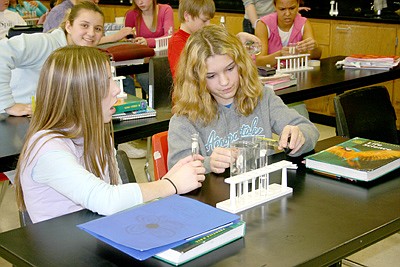
First, the students needed to put the experiment in motion. They filled four test tubes with equal amounts of water, taken from North Center Lake.
The first test tube was used as the control, with nothing added. The next three had varying amounts of fertilizer added. The seventh graders will now monitor algae growth in the test tubes over the new several weeks and record their findings on graphs and a lab journal.
Once a week the students will take the test tubes out of the classroom windows in Mrs. Hinsch’s class and work with their partner to record observations.
Next door, David said his class is studying the affect of fertilizer on algae growth in one large container, emphasizing an understanding of the scientific method, rather than watching algae growth in individual test tubes.
“We’ll also take it the next step and put it under the microscope to see what’s in it,” Pauline said.
Spinette told the students that algae in lakes is not a bad thing.
The students already knew that algae creates oxygen in the water, which is then used by fish and other organisms.
This is good, until too much algae grows. Then, some of the algae is not eaten, it dies and settles on the bottom of the lake. Once there, it prompts the growth of bacteria that feeds off the dead algae. Spinette said the problem comes when the bacteria use up too much of the oxygen, essentially stealing it from fish and other organisms dependent on it for survival.
Fertilizer is used in the experiment because it contains nitrates and phosphates, two key ingredients in algae growth.
Spinette said fertilizers used on lawns and crops enter the water stream when an excessive amount is used.
Some students were a little disgusted to learn that human and animal waste also contains nitrates and phosphates. These can enter the water stream through malfunctioning septic systems or farmers spreading manure on their fields, he added.
“What can we do about this problem?” he asked the students.
Most importantly, farmers and people using fertilizers on their lawns can use less, ensuring that all of the chemicals are used up by the grass and crops and do not pass into the groundwater, he said.
The students were comfortable asking a variety of questions about algae and their experiment, including questions about color.
“Does algae have to be green?” one student asked.
Spinette said green is by far the dominant color of algae, but there is also red algae. He surprised them by pointing out that algae is not all microscopic, pointing out that seaweed and kelp are two examples of large algae types.
It could take up to four weeks for students to see any algae growth in the test tubes, Spinette said. “But after that, growth should be pretty quick,” he said.
He hopes to return to the two Hinsch classrooms at the end of the experiment to observe the results, but it is dependent on a grant he obtained to work on the project, which runs out the end of April.



Comments:
Commenting has been disabled for this item.