March 29, 2007 at 7:24 a.m.
Horses provide therapy at Acres For Life
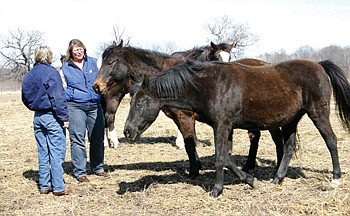
Horses provide therapy at Acres For Life
Moore, of rural Chisago City, established Acres For Life, Inc. on her 20-acre farm about six years ago, but has been really active full time with clients since 2003.
The business originally focused on helping women in leadership roles and in times of transition work on communication and leadership skills. Eventually, men started inquiring about opportunities at Acres For Life for them.
Moore offers time for individuals and groups to work with horses at her farm, where they participate in a variety of different activities designed to help them through stress, crises or whatever challenges they are facing in life.
This is all done without participants ever riding the horses. Moore said the sessions are more about clients building relationships with the horses and seeing how that reflects on relationships in their lives.
"We work on behavior and trust - that is a huge issue," Moore said. "People also come here to overcome fears that have held them back."
She chose to use horses in the therapy sessions because they are uniquely attuned to human feelings.
"Horses by nature use their senses all the time, they pick up on everything. They also don't judge or hold grudges," Moore said.
Acres For Life has several clients dealing with chemical dependency issues, including individuals who have come through the county juvenile system and drug court and adults referred from Hazelden.
A typical session or equine-based therapy is just over an hour for individuals and two or more hours for groups. Most clients have more than one session with the horses and a team that includes Moore and a mental health therapist. Moore has a degree in animal-assisted therapy and a master's degree in chemical dependency counseling and addiction studies.
A session begins with participants are brought into the pasture at Acres For Life to meet the eight horses on the farm. Moore allows time for them to simply quietly interact with the horses and see which animal is the best fit for them.
"I really allow the horses to select themselves for the activities," Moore said. "It has never worked out to try to get the horses to do what we want."
Once the horses and participants are paired up, they complete activities that build trust and communication skills. After each activity, there is time to process what the individuals have learned through talking with Moore and the other therapist on hand.
Moore has had many sessions where the horses have shown her the power of equine therapy.
During one session with chemically dependent individuals, Moore had them each choose a horse. One young man had chosen Zack, the farm's only miniature horse. The two connected and worked well together during their first session, but soon after, Zack became ill and Moore was unable to use him in sessions for several weeks.
During this same period, the young man disclosed that he was also going through a tough period of feeling both physical pain and emotionally drained.
At the final group session, the young man had moved through his struggles, Moore said, and was finally feeling good again.
At the conclusion of the session in the pasture, he asked if he could go into the barn to say goodbye to Zack. As he rounded the corner near the barn, Zack was out of the barn and standing next to the pasture gate. Moore said the two reconnected; it was the first time Zack had left the barn in five weeks.
Working with clients with chemical or mental health issues is just one part of Acres For Life. The other component offered are learning sessions for business professional teams. These groups utilize the therapy activities as a way to improve communication in their office and work on leadership goals.
Moore also makes documented curriculum available to other equine-assisted therapy businesses all across the world. She works collaboratively with one in Pine County called Changing Gates and said the field is growing.
"In 2001, there were about 300 equine-based therapy businesses in the world, now there are more than 3,000," she said.
There are no set hours at Acres For Life, which is part of the family farm where Moore lives with her husband and five children, ranging in age from 15 months to 19 years.
She handles each case on an individual basis when setting up appointments, trying to work with a client's schedule as best she can. This typically means appointments six days a week, but Moore keeps Sundays open for her family.
Acres For Life offers free demonstration sessions, because Moore realizes people may be skeptical.
"You can't really know the experience until being there," she said.
She absolutely loves what she is doing and feels like the business is her destiny.
"I believe it's my purpose. People come here to heal, grow and learn and I'm committed to helping them," she said.
The biggest challenge for Moore is being limited by Minnesota weather.
"We are only able to offer services eight or nine months of the year because we can't be out here in the winter," she said.
The four business partners involved in Acres For Life are working toward a goal of constructing an indoor arena. They hope to offer not only equine services, but other modes of therapy including art and music therapy.
"It would be a place to reclaim that inner light everyone is born with and always has, but they just need the strength to find it," Moore said.
For more information, call Acres For Life, (651) 257-4159 or visit its web site, acresforlife.com.



Comments:
Commenting has been disabled for this item.