Numerous accolades punctuated life of historian and advocate of community Helen McCann White
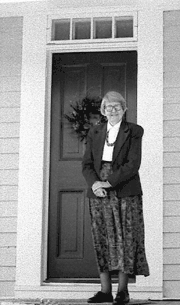
She was born in Minneapolis, October 16, 1916, the daughter of Edward and Elizabeth McCann. Her father was a Methodist minister and she lived in nine small towns in Minnesota, Wisconsin and Iowa during her youth. As a student at Hamline University (1935-39), she worked at the Minnesota Historical Society as an assistant archivist. While attending graduate school at the University of Minnesota, she met Henry Gilbert White; they married in 1941 and had three children: Barbara, Timothy and Bruce. Gilbert's work as a resource economist took the family to cities across the U.S. and to Tokyo, Manila and Paris. During these years, Helen researched, wrote and taught. They spent many summers in Minnesota, living on the family's vacation property near Almelund. In 1965, when the Whites moved back to Minnesota, Helen returned to work at the Minnesota Historical Society. There she pioneered a program of microfilm publication for important manuscript collections; she supervised the Society's acquisition of the Northern Pacific Railroad papers; she conducted oral history interviews of North Shore fishermen; and she worked on early applications of computers in indexing history. In 1970, three years after her husband's death, she left the Society, moved to Taylors Falls, and began publishing The Dalles Visitor, an annual newspaper highlighting the history of the Upper St. Croix Valley. In hundreds of solidly researched, well written articles, she presented the history of these communities to broad audiences of residents and tourists, enriching the lives of many who were surprised to discover how interesting history can be. "People don't see the connection between their roots and themselves," White once said. "But when you can relate history to the lives of everyday people, then they begin to understand it, to appreciate it." The paper is still published by Joanne Frank and well supported by the businesses of the area. White wrote several other books. Her experiences in saving Visitor House were recorded in "A Little Yellow House," published in 2001. "Ho! for the Gold Fields," about the expeditions from Minnesota to Montana, won an Award of Merit from the American Association for State and Local History. "The Tale of a Comet and Other Stories" tells the eight stories of fascinating characters and unusual events that she uncovered in unlikely places. "Saving the River" is a history of the St. Croix River Association. She wrote about Minnesota in the 1830s in "Henry Sibley's First Years at St. Peters or Mendota." Her work as a community activist brought her into areas of controversy. After learning of the destruction of important early records in the Stillwater courthouse, she lobbied for state legislation to reform the state's historical records preservation process. She raised the ire of some when she protested the burning of a historic building on Angels Hill. She served on the State Historic Records Advisory Board from 1976 to 1982. In 1984 White was named Independent Scholar of the Year by the Minnesota Humanities Commission. In 2003 the Chisago County Historical Society recognizes her as Historian of the Year and in 2007 she was honored by the Polk County Historical Society as History Woman of the Year. She is survived by siblings: Phyllis Caine, Rosemary Banta and Edward McCann; children: Barbara Wright, Timothy and Bruce; and grandchildren: Ralph, Richard and Robert Wright and Edward White. Memorials preferred to the Democratic Party and to the Minnesota Historical Society. White's daughter-in-law Ann Regan contributed much of this article.
Comments:
Commenting has been disabled for this item.