February 11, 2008 at 8:33 a.m.
Green Corridor's role in controlling development under scrutiny
Green Corridor's role in controlling development under scrutiny
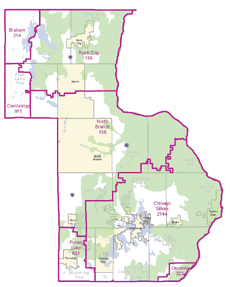
The "Green Corridor" was the result of a joint Washington County-Chisago County effort starting around 1997 and culminating in 2001. The GC was mapped out after dozens of meetings and surveys and other public input, where citizens identified a landmass that included prime farmland, habitat, bird migration routes, viewsheds, etc. considered as priority conservation lands.
The Chisago County corridor connected with the Washington County landmass identified in the same kind of process.
Chisago County, aided by the non-profit 1000 Friends of Minnesota and the Land Stewardship Project used state grants (lottery proceeds), non-profits and foundation funding sources to put together the Green Corridor.
The goal all along was to use four incentive-based tools to preserve the GC: get donated easements, purchase Development Rights, transfer Development Rights and buy the land.
But, as the process neared the point where actual land or conservation easements would be bought, Chisago County pulled back on the idea.
The County Board transferred to Washington County $150,000 in state grant monies that Chisago County officials were not prepared to expend. Chisago county didn't have appraisals on land that owners stepped forward to offer. The deadline for using the grant monies was expiring. The matching $150,000 the County Board had dedicated in a special account went back into the general fund.
Washington County used the money to conserve land towards the south end of that county.
Since then, the Green Corridor in Chisago County basically has served just as a "sending area" for a program allowed under county ordinances called Transfer of Development Credits. (There hasn't been any money for the public to purchase the development credits.)
The theory is that the green corridor can be somewhat preserved by selling development credits off land inside the GC and moving those new plats elsewhere. Landowners in the GC can still get money out of their land investment by selling the credits based on how many homesites their parcels would accommodate, ensuring farmland-open space doesn't get destroyed.
Since 2001, according to county planner Patrick Hollister, several parcels have been rezoned to be Protective and Transfer Districts (PAT), sending their credits elsewhere.
Hollister said 154 acres are PAT with a total of 31 credits issued, with 11 credits becoming actual transferred homesites.
But the real question is how do the people at the grassroots government level-- the township-- perceive this whole thing?
There were 30-plus township officials gathered in North Branch January 27 delving into that.
About half those at the meeting felt it was time to abolish the GC.
The other half agreed the Transfer program and the GC need adjustments. Nobody really felt the program was operating the way it should. Some didn't grasp the concept of transferring credits at all.
Among the discussion items: Townships saturated by GC area are concerned about where in their township development WILL happen. (Amador Township for instance is wholly in the GC.)
~ Transfers are now only allowed within the Chisago Lakes school district. This was done to make sure one district wouldn't lose credits while another district experienced vastly more subdivisions (student population).
The transfer system should go countywide, many felt. Others said transfers should be allowed even within a township. (Not done now.)
~ The density "bonus" given as an incentive to use PAT should be increased. Still, other town officials felt it should be a one:one ratio. (It is 1 to 1.25 now. You create a credit and it bumps up to one and a quarter homesites in the transfer area.)
Planner Hollister and Zoning Administrator Mary Schmitz told the township officials the GC and the transfer programs are getting a hard look.
Some issues the department has encountered in trying to administer this include: neighbors to transfer areas are shocked when they learn the density on a neighboring parcel has been increased.
Also, transferred credits are ending up in areas with natural environment lakeshore, and the nature of these lakes is being negatively impacted.
Staff wants a better tool for determining how many "credits" truly should be transferred-- perhaps requiring a preliminary plat to be done proving developability of a PAT first.
Schmitz said this will be a lengthy review process and there's no immediate action contemplated on the GC or the transfers programs.
In the meantime, developers do have the clustering option or the PUD (planned unit development) option to set aside open spaces and promote the original hopes and environmental stewardship that led to establishing the Green Corridor in the first place.



Comments:
Commenting has been disabled for this item.