July 10, 2008 at 6:59 a.m.
Newest rail museum car was 'mechanical marvel' of early 1900's railroading
Newest rail museum car was 'mechanical marvel' of early 1900's railroading
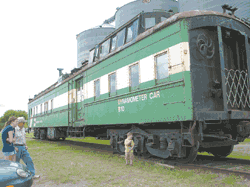
The big, green car, sporting "DYNAMOMETER CAR" painted in neat, white letters on its side drew the attention of little boys who wanted their photo taken while they stood next to the big wheels. Retired gentlemen sat near their parked cars to discuss the mechanical marvels of railroading with anyone who wanted to listen. The car, "B10" was on its way to the Ironhorse Central Railroad Museum near Chisago City, according to Erik Thompson who runs the museum.
In a phone interview Thompson gave a brief history of the car and the museum's plans to restore the rare collectible.
This particular car was built as a baggage car for Northern Pacific in 1915, then converted to a dynamometer in 1928. The few dynamometers in existence are of interest to train historians because this stock exhibits a summary 100 years of railroad mechanical development. In the twentieth century almost every railroad used a dynamometer. It was a laboratory on wheels.
When coupled between the locomotive and the rail cars, the dynamometer was equipped with instruments to measure locomotive performance and monitor rolling stock through hydraulic connections to gauges that read out and printed data. Instruments in the dynamometer car gathered data on forces on the drawbar, horsepower, acceleration, deceleration, resistance to motion on various grades and speeds. Through communication with the engine compartment, the dynamometer laboratory integrated this information with data it recorded on the locomotive power source, including boiler pressure, water level, draft and cutoff.
It was up to the railroad engineers and technicians to interpret this data and determine the exact capabilities of their locomotives and rolling stock in various terrains and conditions. This information enabled them to operate the railroad cost effectively and to develop more efficient locomotives.
There are only mechanical gauges and seismologic type printers in this 76 foot long, 10-foot one inch wide converted baggage car. The instruments in this dynamometer car analyzed the efficiency of steam engines until the 1950's and diesel locomotives from the late 1950's, until the car was retired in 1975. There are no digital gauges or computers.
There is, however, a kitchenette, dinette, bathroom, crew quarters, even a small work area for repairs while in transit. An attendant would make the car his home for months at a time. Assorted engineers and technicians were constantly on and off the dynamometer as it ran tests while transporting every consumer good; rolling across all the terrain and through all the weather conditions of the United States.
The Burlington Northern Railroad donated B10 to the Lake Superior Museum of Transportation in Duluth where it was stored until Ironhorse Central Railroad Museum purchased it this past year. Then, Ironhorse Central stored it on a siding in Rush City until a few weeks ago, when the dynamometer car felt the tracks warming again.
First, there were two round-trip rail rides up to Hinckley for fortunate railroad enthusiasts who wanted to learn about this important part of railroad history. The car made its way to the end of the Saint Croix Valley line in North Branch, as close as rail could take it to its new home, in rural Chisago City. A moving crew installed pneumatic tires under the eighty-ton car to prepare to transport it on country roads to the museum, six miles south of Lindstrom on CR85.
Erik Thompson estimated the cost of restoring the Dynamometer Car to exhibit its 1950 functionality at a value of $200,000, paid for by donations and proceeds from the museum. He quickly added, however, that the restoration could never be accomplished for that price if hired out. Dedicated volunteers and the Thompson family have set a goal to have the exterior of the car restored from Burlington cascade green to Northern Pacific "two shade green and white" by next summer. Ironhorse Central will host a day of the NP's annual convention. Restoration of the interior will take another two years, he predicted.
While the car will be restored to its Northern Pacific era, Thompson pointed out that BNSF has been extremely supportive of this project. NP is a predecessor railroad to BNSF and therefore BNSF has an interest in preserving the history of a car that played a significant role in the company's success.
BNSF donated the transportation costs of the dynamometer car from Duluth to Hinckley. The St. Croix Valley Railroad organization donated the move from Hinckley to North Branch.
Due to rising gas prices, many area residents are staying close to home this summer to entertain their families and visitors. They are finding that The Ironhorse Museum is a quality local attraction. Thompson mentioned that visitors should plan to spend a minimum of two hours on the museum grounds. Visitors can roam the grounds and exhibits at their leisure, participate in tours, museum rides and special events. There are pleasant, clean picnic grounds, and the site can be reserved for groups, parties and reunions.
Visit the museum website www.ironhorsecentral.com and the museum Thursday-Saturday during the summer from 10 a.m. to 5 p.m.

Comments:
Commenting has been disabled for this item.