March 27, 2008 at 7:20 a.m.
Collecting buttons becomes a study in history for local club members
Collecting buttons becomes a study in history for local club members
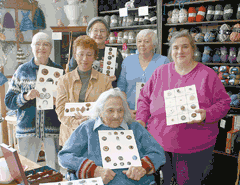
Her name is Marie Hutchinson, a spunky 95-year-old local resident who has added more buttons to her collection than she can count.
The buttons in her collection aren't the pin-on variety, but the kind of buttons invented with the most practical of purposes in mind - to hold together clothing.
It started when Hutchinson acquired a small box of buttons from a local collector's inventory after the collector died about 20 years ago.
Since then, Hutchinson has been passionate about collecting, but not because some of the buttons are valuable monetarily, but valuable as pieces of history.
Each new button that she acquires leads Hutchinson down a path in history. She wants to know everything about each button she collects - when it was made, who used it and even about the culture and historical events surrounding the button's creation.
Some of the first buttons in her collection were made from old coins, and Hutchinson then set out to learn about each of them.
The buttons have helped Hutchinson learn about different cultures, history and geography.
"One thing leads to another and you learn so much more than just about the buttons," Hutchinson said.
She is helped out by her daughter, Mia, and the other members of the St. Croix Button Society. The 8-12 club members meet monthly in Chisago City to show off some of their finds pertaining to that week's chosen topic or theme. Despite the name, club members come from all over, including the metro area and Wisconsin, to meet.
Mia offers help through searching the Internet for details about buttons in Marie's collection, as well as scouring online auctions such as ebay for buttons.
The duo also purchase buttons from collections being sold off, and find them at antique stores or button dealers. Hutchinson likes the idea that more buttons dating back to the 14th and 15th century are now being found with the use of metal detectors.
"It's bringing back a piece of history we thought was lost," Hutchinson said.
Hutchinson's collection is vast and varied, and includes buttons made in every material - metals, fabric, bone, glass - except plastic. "I don't like the plastics," she said.
She has "realistics," which are in the miniature shape of real items, hand-sewn fabric buttons, hand-carved buttons made from a variety of materials, "smuggler's buttons," which resemble small metal cages used to smuggle jewels in the 17th century and buttons made with pearls, jewels and precious metals.
Some of the oldest buttons in her collection date to the 15th century, and Hutchinson has relished in the daunting task of figuring out how each button came to be and where it has been throughout hundreds of years.
Hutchinson knows that button clubs started in the 1940s as a way to organize button boxes that were stored away in attics and basement shelves, and she wants to continue that tradition.
While the club members compete at the state and national club level in button competitions, she doesn't focus on that aspect of collecting.
"What makes it fun for me is the history behind these things," she said. "Buttons are an important part of culture and history. I view them as an art form. You can see art from the last 200 years represented in buttons."
Last week, the button club assembled at Cottage Gifts in Lindstrom and offered an open house to others interested in button collecting. Although only one collector showed up looking for more information about buttons in their collection, but group enjoyed browsing through cards of buttons they had brought and visiting over tea and snacks.
They also had work to do, preparing a card of buttons for display at the next national competition for button collectors.
Guidelines for competition are rigid. Buttons entered in the competition must include correct information on materials, dates and the history of each button - and neatness and spelling count.
If something is wrong about the display, the competitor receives a mark against them, known as a "measle."
Usually, club members compete individually at the contests, but this time, they are assembling a submission of metal buttons as a team. Several buttons from Hutchinson's collection are being used, dating from the 15th century and newer.
The club enjoyed its first-ever open house, and Hutchinson already has plans to host another one. She said it will probably be on a Saturday, to make it a more convenient time for prospective button collectors to stop by and learn the history of their collections.
For more information on button collecting, go to the national website, www.nationalbuttonsociety.org.


Comments:
Commenting has been disabled for this item.