September 5, 2008 at 8:41 a.m.
Lindstrom Methodist Church is 150 years old
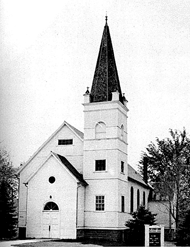
Lindstrom Methodist Church is 150 years old
It was slightly more than a century and a half ago that a number of Methodists met on the shores of present South Lindstrom Lake and held outdoor camp meetings that sometimes lasted several days - or until the mosquitoes drove them away. A little later a couple of the more daring Methodists even infiltrated the much larger Lutheran congregation in Center City and tried to win a few converts. After all, they pointed out, the Methodist had been gathering every Sunday since spring 1859 in their handsome log church perched high on the Center City peninsula, while the 5-year old Lutheran congregation was still meeting "down below", town near the junction of present County Roads 9 and 37 in someone's barn; although, that situation would change dramatically.
By 1866 the Lutherans had raised a new white frame structure on what became known as church hill. That, and their spacious brick church built later in 1882, probably proved too dominating for the smaller band of Methodists whose little log church was literally in the shadow of the larger Luther edifice. Then came the railroad.
Trustees of the Swedish Methodist Episcopal Church of Center City must have begun to squirm. Where it had previously been necessary to travel seven miles around the lake, from Chisago City to Center City, following rough wagon roads, by 1880 the new railroad had filled in shallow areas east of what is now the Middle School to create a new, direct route across the Lake. Daniel Lindstrom watched travelers crossing his land using the new shortcut and decided to plat his homestead into saleable lots. The village of Lindstrom was really established when the first store went up in 1880. Shorly thereafter the Methodist congregation in Center City took a vote and decided to sell their log church and move to the newly emerging village of Lindstrom. For $800 a lot was purchased in Lindstrom, on St. Croix Avenue (now Lake Boulevard) and in 1892 the Methodist move was made.
The first Methodist church in Lindstrom was used for 76 years and is now the Masonic Hall. The original parsonage constructed in 1894 has since been moved to a location on Olinda Trail. In 1948 a congregation in Panola agreed to merge with the larger congregation in Lindstrom, as had other small congregations in Wisconsin, Scandia, Wyoming.
Then, in 1968 the present brick and glass house of worship was consecrated as the congregation proudly marched from the old Lake Boulevard church to the new one at Third Street and Irene Avenue. Even rainy weather didn't dampen their enthusiasm.
Today, Pastor Dan Doughty and his flock are in the midst of a series of commemorative activities befitting an organziation observing its sesquicentennial. From a primitive log church in what was then Village of Center City to a modern structure in the City of Lindstrom, a lot of stories have been told since the birth of that congregation in 1858.



Comments:
Commenting has been disabled for this item.