August 20, 2009 at 7:40 a.m.
Teens gain valuable work, life experience through summer youth work program
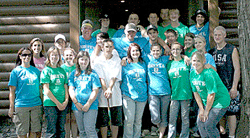
Teens gain valuable work, life experience through summer youth work program
As they shared cake and refreshments, the students and their supervisors were able to reflect back on the vast amount of projects that were accomplished during their nine weeks of work, and showed pride in what they had done.
CLHS Work Experience Coordinator Stephanie Bushard, along with teachers Joy Ruce, Mary Klick and Andrea Ryan, led the program as supervisors of the 15-18 year olds.
Grant funding became available this past spring through money received by Central Minnesota Jobs and Training Services (CMJTS).
Bushard said she and other staff identified students who could benefit from the program.
"The students had to qualify based on certain situations such as at-risk students or those with special needs or low income," said Craig Bestick, who helped to oversee the program as a representative of CMJTS.
Around 40 students applied for the program. The hiring process included a job interview.
From there, 24 students and six alternates were chosen. Bushard said the alternates were put on a waiting list, in case any of the students were unable to complete the work program.
At the same time, Bushard was working to establish partnerships with the school district, Lakes Area Police Dept. and the cities of Lindstrom and Chisago City, to set up a work schedule for the students.
"The idea was to develop their work experience," Bushard said. "Most of these kids had minimal experience."
Following an orientation session, the students started working June 16. The day started promptly at 8 a.m., and wrapped up at 2:30 p.m.
Bushard said expectations and rules were clear from the beginning.
"They were told to arrive at 8 a.m. each day, and we had no tardies all summer," Bushard said.
The importance of using time wisely extended to the expectation that supervisors at work sites would also be fully prepared for the students when they arrived.
"We talked about being tardy or not having the site ready for work. Even if it's 10 minutes, multiply that by 24 [students] and that's four hours of work that could have been done," Bushard said.
Students heard an overview of the day's projects, and were on their way to the job site by 8:15 a.m. each day in school district-supplied vans. It was just one of several in-kind donations required of the grant, Bushard said, and the vans were vital to its success.
Each day, three of the program's supervisors accompanied the teens, in groups of eight and teamed with a supervisor.
Even before the students left the high school each day, they were proactive in their attitude toward the day's projects.
"We would lay out the project and then discuss possible problems and challenges that could come up, and how we could deal with them," Bushard said. "We talked about using skills like teamwork, problem solving and communication."
Kids were assigned as crew leaders in each group, and were able to discuss how to get the job done utilizing everyone's skills in the group.
At 1 p.m., the group finished work for the day and returned to the high school for lunch. From 1:30 to 2:30, the group discussed the day and completed journal worksheets.
The worksheet asked them what they learned from the activity, what skills helped them complete the activity, and what the most challenging and most enjoyable portions of the activity were for them.
The days of sometimes very tough manual labor were rewarding, especially when the students could see the fruits of their labors, Bushard explained.
The crew's first job was to clean lockers and cafeteria tables at Chisago Lakes Middle School. Bushard said the students noticed on that first day how a person's actions affect others.
"There was a lot of self-awareness when they saw all the gum under the tables," Bushard said.
Awareness of actions continued when the group spent time cleaning up Camp Ojiketa for the city of Chisago City, where they saw what vandals had done.
Chisago City Parks Director Doris Zacho said the city simply could not have accomplished all the projects completed by the students this summer.
"It was a blessing for me, that's for sure," Zacho said. "They were very hard workers, doing everything that we asked of them and also doing jobs that they just saw needed to be done."
At Camp Ojiketa, the teens worked to clean up four years worth of dirt, grime, leaves and sticks that had accumulated since the camp was last used. In preparation for Safety Camp, the crews cleaned Zonta Hall "from top to bottom," Zacho said, and completed other projects such as painting, washing windows and floors, and repairing picnic tables.
They also weeded in parks and planted shrubs for Chisago City, and weeded in Lindstrom. The crews spent time at Lindstrom Beach restoring the shoreline, pulling weeds, raking and picking rock.
Two days were spent spreading wood chips on Lindstrom trails. Bushard said it was difficult work, hauling wood chips up to three-fourths of a mile in wheelbarrows, but none of the kids complained or wanted to quit.
At Taylors Falls Elementary, the group painted playground equipment and new four-square games on the asphalt on a day where the blacktop surface felt like 120 degrees, Bushard said.
They also helped lay sod and clean the greenhouse at CLHS, and dismantle ice rink boards in Lindstrom.
Every two weeks when timecards were sent in, individual student goals were set, and then evaluated by the supervisors.
Bushard said the variety of projects
allowed each teen to gain skills needed in a variety of jobs, which was one of the program's goals.
Along the way, the kids learned valuable lessons about the workplace - and life, Bushard noted.
"The words I keep coming back to are self-discovery," she said. "They learned about what they can do, what their good at and what they can use to get a job."
Bushard and Bestick both realized the teens formed bonds, despite knowing very little about each other when the program started.
"They came in here not knowing each other and by the end they were friends," Bestick said. "A lot of them said they wouldn't have gotten to know each other any other way."
Bushard was excited when she noticed the group wasn't simply working side by side - they were working as a team.
After the wood chipping projects in Lindstrom, some of the teens brought back a large wood chip shaped like a hockey stick. "They painted it a very bright yellow," Bushard said. The teens transformed the stick into "The Golden Wood Chip Award" and started presenting it to fellow workers for a job well done.
It was then that Bushard knew they had taken their work ethic to the next level. "When you start developing your own traditions like that in the workplace, it's a very healthy environment," she said.
Outside of their work experience, students gained valuable knowledge from their supervisors about careers and job skills. They learned about job hunting strategies and creating successful resumes, and how to use their skills and talents to get a job.
Two students were graduates off to college, but the rest will be back in class at CLHS this fall. Bushard said she told all of them that her relationship with them hasn't ended with the program.
"We are their mentors," she said. "I told them we're all here to help them with resumes, job applications, whatever they need."
Bushard received a lot of positive feedback from parents, many who expressed noticing a change in their children.
"They were taught the concept of working hard versus working smart," Bushard said. "They started looking at better ways of doing things. Parents told me they were using that phrase when helping to complete projects around the house."
Bushard said she would like to offer the program again next summer. She and Bestick are hopeful that some of the $1.6 million Jobs and Training recieved will still be available for a grant for a second year.
"Unemployment in this county is at about 10 percent," Bushard said.
"Without this program, most of these kids probably wouldn't have had a job this summer," Bestick added.




Comments:
Commenting has been disabled for this item.