December 3, 2009 at 8:21 a.m.
Commissioners need more info on emergency radio system rebuild that will run several million dollars
Commissioners need more info on emergency radio system rebuild that will run several million dollars
Chisago County is carrying the ball for ambulance, for city police, firefighters, even public works personnel who rely on what will be the next generation of communications equipment.
The difficult part for the County Board has been adopting THE PLAN.
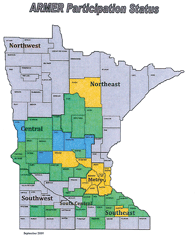
The Board last week in its second full airing of the issue voted unanimously to notify the Metropolitan Emergency Systems Board (MESB) that the county will be using the "ARMER" system. This is a statewide initiative to coordinate all Minnesota communications systems under the Allied Radio Matrix for Emergency Response. The MESB is holding $1.2 million earmarked to aid Chisago County in the implementation of 800 MHz public safety communication. The funds will be released when the MESB is notified of the decision to pursue ARMER.
Exactly what this network will look like in Chisago County is still up for debate.
It may require two new towers to be erected, it may need three or four. It may allow for portable radios to be able to communicate in "light" construction buildings or "heavy" built structures. The county may go for total radio reception coverage or "dead spots" could remain in the county.
The county commissioners have rejected one option. This involved rolling the county's Public Safety Answering Point into Washington County's dispatch center, which would have eliminated a local 911 center.
There's still four options that the commissioners must narrow down to one preferred system. The options range from an estimated $6 million to $9 million.
Sheriff Todd Rivard pushed for a plan decision last week but met resistance. Rivard explained that the county's equipment is past its expected lifespan, adding, "We have gotten by cheaply for many years...it's no secret this (rebuild) will be expensive."
Commissioner George McMahon said he needs specific cost information before reaching out to city councils for their share of funding this effort. Commissioner Lora Walker also wanted more detail on long term operating cost differences among plans.
Isanti County is also in the early phases of implementing its own ARMER network and Commissioner Ben Montzka stressed that Isanti needs to be contacted for the possibility of shared towers, etcetera, before he'll commit to any option. Commissioner Rick Greene said he's spoken with an Isanti County commissioner who supports sharing portions of systems, but there's been no official offer extended. Sheriff Rivard responded that Isanti County isn't at the same stage as Chisago is in moving forward. Also, if Chisago should decide to make its network capable of penetrating heavy buildings, Rivard was under the impression Isanti County is pursuing only light building reception/transmission capability.
Commissioner Mike Robinson also questioned how the options translate to space. Does the county have to build a facility to house the new communications center, or will it fit somewhere in an existing county-owned building, he wondered. (If the new county jail had moved forward there was a comm center rebuild in that pricetag.)
Independent communications consultant, Jeff Nelson, recommended to the County Board his "minimum" acceptable scenario. This calls for the upgrade to 800 MHz with two new transmission sites in Stacy and in the Chisago Lakes areas to serve the greatest population concentrations. This would "position" the county network structure for later enhancements.
Adding a tower in the Almelund area (another option) greatly improves reception/transmission within the river valley area, and Wild River State Park terrain. And, a tower in the Rush City area (another option) boosts capability in the northwest corner of Chisago County.
All plans require new fixed and portable radios and new pagers.
This local study of systems began about February 2009 with the goal to meet a mid-1990s mandate from the Federal Communications Commission (FCC) for all two-way radios operating below 512 MHz to use narrowband mode by January 2013. There will be no "significant" wideband license revisions after January 1, 2011. All equipment or systems that can not be reprogrammed to narrowband face replacement.


Comments:
Commenting has been disabled for this item.