January 15, 2009 at 7:21 a.m.
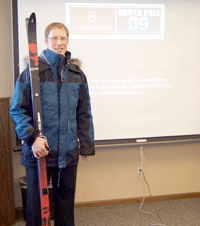
CLHS grad heads up North Pole expedition
CLHS grad heads up North Pole expedition
Tyler Fish, who grew up in the Chisago Lakes area and graduated from Chisago Lakes High School, will be leaving northern Canada next month along with fellow adventurist John Huston. Using just cross country skis and occasionally snowshoes, the duo will become the first Americans to take an unsupported expedition across the Arctic to the North Pole.
Unsupported as in the two will receive no outside help during the course of their estimated 65-day journey. They will rely only on their own strength and the supplies and equipment that can be towed behind them on sleds.
Fish explained the training and preparation involved and their expectations for the trip when he spoke at the Jan. 6 Chisago Lakes Rotary Club meeting in Center City.
Fish grew up enjoying the outdoors, spending winters skiing and summers on camping and canoeing trips with his family.
His hobbies mesh perfectly with his job at Outward Bound, an Ely-based international organization that provides outdoor education experiences. Fish works with at-risk kids as the youth program coordinator.
Huston also works at Outward Bound, which is how the two met. They started formulating their plan to reach the North Pole about three years ago. It wasn't just a focus on completing a journey that has been accomplished by few before them, however.
For Fish and Huston, the trip is a chance to emphasize their personal values and let those serve as an example of achieving your goals.
Their mission statement for the trip revolves around the values of optimism, humility and responsible action.
Fish gave a slide presentation to the Rotary members, showing scenes of unforgiving white landscapes like what they will see for 65 days. He admitted, not very exciting to look at most of the time.
"It's not about the destination, because there's nothing there," Fish said. "It's about the journey."
He joked that the anonymity of the snowscape is replicate throughout Minnesota in the winter and he could have passed the North Pole several times just driving to the meeting that day.
Planning a 65-day unsupported journey across ice floes, frigid open water and snow plains made blindingly white by an anemic sun poses its own challenges that could make or break the journey.
Fish and Huston will travel sometimes hundreds of miles a day on their skis, using ski poles to guide them along while towing two sleds each full of gear and supplies. Everything they need - from food and cooking supplies to a tent, compass, GPS and satellite phone - will be in the sleds.
Their first challenge of the trip is not so obvious. Sure, 50 below zero is extreme, but combined with 100 percent humidity it can mean clothes and gear that never dry once they're wet.
Follow that challenge with intense winds that aren't impeded by obstacles for hundreds of miles, and the possibility of polar bears taking an interest in a couple of warm bodies moving across the snow.
Days of very little daylight will mark the beginning of their journey March 1, but by the end of the 65 days, the sun could be out close to 20 hours each day. It will be a challenge working to find a balance between time to move and time to rest, even if there's still daylight, or they have to move through the darkness.
Fish said the next challenges are open water and how to get the sleds across. Through perseverance, they figured out they would be able to paddle across using the sleds as makeshift canoes, but there would still be the challenge of getting all the gear across the water.
They will need to assess every situation as it comes up and remain flexible, Fish said. The more likely scenario will be to either wait for the water to freeze or move somewhere else and find a natural bridge to cross.
Drifting is another challenge. The ebb and flow of water and ice could erase an entire day's mileage overnight.
"The key is to keep moving," Fish said.
Preparing for these challenges is key. The two have spent extensive time pulling strings of tires on grass for strength training, and donning wet suits and plunging into 30 degree water.
Food preparation has been the equivalent of science experiments along the way. Fish showed slides of combining ingredients to make what he calls "breakfast cookies" that will be a staple each morning, and the baking of pounds and pounds of bacon - "we called it the bacon factory," Fish said.
They expect to burn an average of 7,000 calories a day, so the staples of their diet will be two things, Fish said - fat and meat.
Of course the weight of everything they are bringing is a big factor. Every item, from food to toilet paper, has been weighed and tabulated against a maximum weight each man will pull.
The days will generally be the same on the expedition. Upon waking, they will brush the frost off the interior walls of the tent - "otherwise, sooner or later, it will start to rain," Fish said.
Breakfast will be made and eaten and everything packed up to start the day. They have practiced breaking down and setting up camp to make the process as fast as possible.
"Sooner or later, we have to get out of the tent," Fish joked, to face whatever weather or obstacles the day may bring.
What they will see may seem boring: "white on white sky, white on blue sky or white on gray sky- that's it," Fish said. "But it's not boring really, there is something new to see every day," he said.
Some days will be long, some will only be four hours of travel because of the lack of daylight.
Fish said the general routine will be to travel for about 1.5 hours at a time, take a break, then keep going.
Sleep is important, and they will be sure to get a full night's rest. The tent is pitched using ski poles, doubling up the use of equipment to lighten the pack load.
"If you're going to carry more weight, it should be food because you can use it," Fish said.
Because the landscape is basically the same and there is constant drifting, keeping on course with a Global Positioning System (GPS) will be critical. The two will also have a compass and satellite phone.
At some point each day, the duo will take time to write in their personal journals and record audio or text entries for a blog on their web site, www.forwardexpeditions.com.
Fish said they will be sending an update to the web site via their satellite phone, Palm Pilot or some other PDA device at least every other day, so friends, family and supporters can monitor their progress.
The duo truly believe in the power of positive attitude to overcome the obstacles they will face on their expedition.
"Optimism is inspiration, a feeling of belonging, purpose and luck - that's my take on it," Fish said. Part of being optimistic also is losing your fear, he added.
The team will leave for Canada in early February, where they will start becoming acclimated to the harsh Arctic temperatures, and head out for the Pole March 1. At the end of their trip, a helicopter will pick them up and take them to Norway before they head back for Minnesota. They plan to be back at work at Outward Bound around mid-May.
While some of the trip budget has been trimmed, Fish said original estimates were around $350,000. Fortunately, they are supported by corporate and individual sponsors, including Victorinox (makers of the Swiss Army knife), Bergans of Norway, Delorme, Adventure Medical Kits, Best American Duffles-BAD Bags, Brunton, Brynje of Norway, Dermatone, Energizer, Fisher Space Pen, Gator Sports, Granite Gear, Thermos and Wapiti Woolies.
They have also partnered with Caring Bridge to try and raise $100,000 for CaringBridge.org, which offers free personalized websites that support and connect loved ones during critical illness, treatment and recovery.
Their web site is already jam-packed with information, including blogs, video and photo galleries and educational materials.
At the end of the Rotary meeting, someone asked the question that probably always is asked of Fish: why do this?
"Remember doing connect the dot puzzles as a kid? This is kind of like that. It's a series of events that happen and you think at the time, it's no big deal, but all of a sudden you realize you have the whole picture. It's also about timing being right and choices you make," Fish said.


Comments:
Commenting has been disabled for this item.