July 30, 2009 at 7:28 a.m.
Five Counties may lose methane off-set credits under new rules being adopted by Congress; Commission counting on the revenue
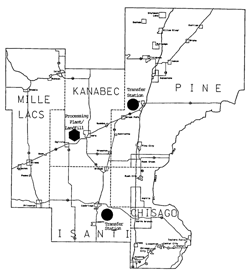
Five Counties may lose methane off-set credits under new rules being adopted by Congress; Commission counting on the revenue
The director has since resigned from the five-county agency, but the Solid Waste Commission continued to pursue credits. After a not-very-productive experience with the Chicago Climate Exchange the East Central Solid Waste Commission is now partnering with a California exchange and looking forward to a much improved revenue stream-- but now limited participation by landfills in credits exchanges is being considered by Congress.
The new ECSWC Executive Director Janelle Troupe says the ECSWC is close to realizing considerable income from credits it has to market. The Chicago effort attempted during the first part of 2009 ended up only netting the commission "very minimal" profit, she added, after costs for installing flare equipment, and paying annual dues of $5,000, (charged three years retroactively for exchange expertise). The ECSWC directors took another look at the sale of carbon credits. Today, ECSWC has the project listed on the California Climate Action Registry.
Future estimated credits are already claimed through 2010. The buyers are companies who need to offset their greenhouse gas creation by supporting other entities who have credits to spare-- like the solid waste commission, a joint powers group. By reducing the amount of methane gas discharged from the landfill directly by flaring it, the ECSWC gets "credits" that offset others' carbon gas creation.
Troupe said a "verifier" dispatched by the exchange is doing a site visit August 10.
She estimates the ECSWC might be cleared to market approximately 57,000 credits (based on the efficiency of the burn off and other factors.) This could bring in $250,000 for the rest of 2009 and $350,000 in 2010, she added.
The ECSWC has collected landfill gases from the landfill located just outside of Mora, and destroyed them by flare method since 2005.
In an effort to promote the reduction of gases like the landfill gas, agricultural gases, etc. the exchange system was devised where a regulated exchange (like a stock exchange) would allow entities that generate gases to buy "credits" to off-set their pollution.
The locally anticipated revenues are going to be affected by what's happening in the federal government. Those in the landfill industry opposed an effort to exclude landfill methane from unlimited credits and are perplexed over excluding landfill methane projects from qualifying for credits under the Waxman-Markey Bill. (HR 2454) This House action currently only allows credits for ag-related or for enteric fermentation projects and coal mine methane reduction.
The solid waste industry noted that in the EPA's analysis, the environmental protection agency said 45 percent of the total pool of methane emissions would be left out from qualifying for credits. Congress is apparently setting credit limits to reduce all greenhouse gas creation equitably in all regions of the U.S.
In an article in the Waste Business Journal, "To date the off-set credits have been an important economic incentive for developing methane reduction projects. The importance of methane based off-set projects is almost universally acknowledged by industry and environmental groups," the article adds.
Troupe explained that the five-county landfill operation is "...struggling with increased costs and reduced tonnage. Tipping fees were down last year...we are hoping that the sale of carbon credits will balance our budget. We worry that (new standards and the exclusion) may take away our ability to sell carbon credits."
John Schadl, Congressman Jim Oberstar's spokesperson, explained that the limit on credits is part of the House bill and in a bill the Senate is still working on, and then a conference committee will get the bill. Schadl stressed that the credits available would be limited anyway under a Supreme Court decision that the EPA has jurisdiction and should exercise its authority to make new standards for performance. The EPA would proceed to make its own caps and restrictions on credits if Congress hadn't set a cap itself, Schadl said. It was a case of protecting Minnesota from potentially even more restrictive standards and reduction in credits being adopted, he said.



Comments:
Commenting has been disabled for this item.