March 5, 2009 at 7:25 a.m.
Lake Improvement Dist. has new focus entering its third decade of existence
March 5, 2009
Lake Improvement Dist. has new focus entering its third decade of existence
Spetzman went on to explain some of the efforts the LID will promote during "this time of transition."
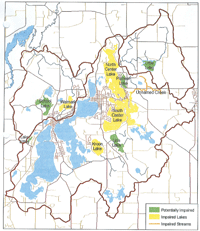
The LID expects to see four additional lakes within the overall watershed listed as impaired in 2010. Already four lakes in the LID are on the 2008 state impaired waters list. (See map.)
Under state law when a body of water receives an "impaired" rating it triggers a study of the Total Maximum Daily Load of unwanted nutrients and pollutants (the TMDL.) Casey Thiel, Chisago County Soil and Water Conservation District says TMDL is basically a calculation to estimate the amount of any pollutant that can enter a body of water (phosphorus, ammonium nitrogen, etc.) and still allow the body of water to meet quality standards. The source(s) of the pollutants is identified along with the amount this source could contribute in daily load.
A monitoring plan begins in April 2009, adding a few locations within the chain of lakes watershed to help identify pollutants and learn more about flow into the lakes.
The Sunrise River in North Branch has undergone a TMDL study. The Soil and Water Conservation District, headquartered in North Branch, oversaw that study. LID Board members would like to see this agency do the TMDL study on the Chisago Chain.
Last week the County Board approved a Letter of Agreement to work with the PCA. The commissioners approved a request from the LID Board to spend $13,700 for "surface water monitoring" and the state's Pollution Control Agency will cover about $34,000 for lab work and tests on samples.
Spetzman said few TMDL studies are starting in the state in 2009, and the LID should be commended for coordinating this joint effort. "Due to the foundation work already completed (previous LID projects) and the location of this chain of lakes to the Sunrise River Watershed," Spetzman said the PCA accepted this TMDL study as a partnership.
The Soil and Water Conservation District has already put together a "monitoring plan" and located areas where water quality science data is lacking. The SWCD has also put together a binder of information on zoning, land uses, soils and other factors.
All this studying and information gathering is in anticipation of the LID becoming eligible for receiving sales tax revenues dedicated in last fall's general election to support the "Clean Water Legacy" amendment. Revenues are expected to start to become available beginning July 2009.
Spetzman said ideally all this work and effort will end up qualifying the county for funding to do stormwater projects, filter strips on agricultural fields, stabilize gullies and many other measures addressing water quality of the Chisago Chain.



Comments:
Commenting has been disabled for this item.