March 12, 2009 at 7:37 a.m.
Additional early details on proposed electric station involve re-use of wastewater
March 12, 2009
Additional early details on proposed electric station involve re-use of wastewater
Blake Wheatley, LS Power General Manager, made it clear this was a very preliminary sharing of information.
The permitting process will afford much greater public involvement and comment. LS Power, in pursuing the natural gas-fired (with fuel oil backup) independent power plant, will need permits from a host of agencies.
The project also will not happen without special legislation, it was explained.
LS Power is seeking to have this site exempted from Minnesota personal property tax, which it was successful in doing for another Minnesota plant that LS developed.
Rep. Kalin and Sen. Olseen are carrying the bills that would allow for this. Wheatley said all the other "industries" in Minnesota are exempt but for some reason utility operations have not been. Without this reduction in future tax liability for this facility, LS Power won't build.
The exact size of the facility in terms of power output hasn't been decided. The interconnection capability of the electric grid is still under evaluation. Wheatley did say the plant under consideration for Lent Township will be bigger than the existing facility developed by LS Power in Cottage Grove, MN.
Rep. Kalin stressed this meeting was called informally, to promote "open conversation" about this potentially $300 million project. He said the company has much more design work and information-gathering to do.
Wheatley explained that the site being evaluated offers a convergence of desireable factors -- proximity to the Xcel Substation for access to the power grid, it's in a rural area, it is very close to natural gas supplies and there is a possibility the power plant can get water for its cooling tower from a wastewater treatment plant, a few miles south.
The impact of the power plant on the aquifer was obviously a concern to some attending this meeting. The "Sunrise River Energy Station" is going to need one million gallons daily in flow. It's estimated 5 million gallons of water would be a daily maximum that will flow into the system, only at peak demand.
Wheatley said LS Power has done no test drilling at this point. He explained that any state permits will require the company to demonstrate to regulatory agencies the power station wells will not interfere with local wells.
Tapping into sewer plant
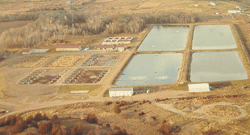
A hoped-for scenario would allow for clean Chisago Lakes sewer plant effluent to be piped in for much of the power plant's needs. Wheatley cautioned that the analysis of re-directing sewer plant effluent through a pipeline to the Sunrise River Power Station is incomplete.
Another advantage of combining the station with the Chisago Lakes Joint Sewage Treatment Commission facility is that it has several million gallons available (in storage) and depending on how often the power station operates all or some of this could be used.
The CLJSTC facility could also be helpful in the discharge process. The power station spent water might be re-routed back to the sewer plant for discharge from where it came. By releasing the power station's wastewater into the sewer plant discharge tributary, Wheatley said LS Power avoids direct discharge into the Sunrise River. The sewer plant already has a discharge "structure" which means LS Power isn't redundantly introducing yet another discharge structure into the ecosystem. (See page 2 for CLJSTC committee discussion.)
Water discharged from a plant such as this is "mostly cooling tower blowdown," according to the LS Power information packet. Typically there's about one million gallons of water expelled from the plant, daily.
A few citizens questioned the composition of the discharge.
Wheatley said LS Power plants elsewhere use additives to keep mineral scale from building up, and a light solution of bleach so bacteria doesn't thrive, plus other substances can be present in discharge.
Sen. Rick Olseen questioned if a closed looping water system couldn't be developed for this plant. Wheatley said the water has to be expelled at some point due to the plant design.
There are also restrictions in Minnesota as to the difference in temp between the discharge water temp and the temperature of the water body it's entering, Wheatley added. Again, there will be opportunities for public review and comment to the Pollution Control Agency, during the discharge permit phase.
Additional highlights:
~ The plant will not include anything taller than 200 feet. There will be storage tank(s) for backup fuel.
~ The combined plant (natural gas--oil) has a carbon footprint of about half what a coal fired plant produces.
~ The company estimates about $900,000 as its annual property tax bill.
~ The 40-acre parcel owned by Frank Dusenka is under an option, purchase by LS Power will depend on various factors.
~ Construction will take two years, timetables show groundbreaking well into 2010 or 2011.
~ The certificate of need process would require LS Power to have future contracts in-hand from buyers of the peaking electric supply. Wheatley said company personnel are developing those buyers now.
~ No additional powerlines are part of this project. There will be a connection to the existing substation. There may be system upgrades needed to transmit the boosted power, but that would be a network decision.
~ Lent Township is the local responsible government unit on this project.



Comments:
Commenting has been disabled for this item.