March 19, 2009 at 8:17 a.m.
Update on Tyler Fish Expedition
March 19, 2009
Update on Tyler Fish Expedition
Noren's dad, Gary, says it's been "exciting to follow their progress" on two websites allowing friends and family to stay abreast of the separate expeditions.
Anders and Tyler, Noren adds, were "nearly inseparable in high school."
If the goal of public schools is to nurture limitless curiosity about the world and give students skills with which to satisfy that curiosity; then Chisago Lakes instructors hit the jackpot with these two young men.
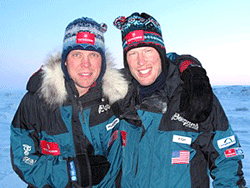
Fish; whom readers met in a January 15 feature story, is currently into week three of his trek to the North Pole. He embarked with fellow explorer John Huston, March 1, out of Ellesmere Island, Canada.
Fish's satellite phone updates are at www.forwardexpeditions.com. So far so good, Fish says of the expedition; although there's a few hundred miles ahead of them yet. Each day Fish and Huston log a brief diary. The miles they're able to cover daily have grown since a very slow start in minus-50 degree conditions.
Fish and Hudson aim to complete the first-ever unsupported trek (no machines, no dogs, no planes) to the North Pole, by approximately April 26. In a recent dispatch Fish says since the sea ice on which they travel is constantly shifting and moving, he and Huston could end up skiing a total of 525 miles, with all the zigging and zagging. (As the crow flies the route is 475 direct line miles, Fish said.)
The two explorers are taking breaks for 90 minutes every nine to ten hours of travel. Their sleds weighed in at 260 pounds, which each one is pulling.
Fish explains that upon making it to the North Pole they will contact a crew waiting to take-off about 100 miles from the pole-- be picked up by a Russian aircraft and flown to Svalbard, Norway, then Oslo, and return to the U.S.
What they learn about human nature in this alien environment and how their equipment responds to the conditions will become invaluable for future trekkers and if successful, will set the exploration bar ever-higher.
Meantime-- Anders Noren, Fish's close school friend, is directly across the Arctic Circle, in Russia. Noren is researching global warming with a team affiliated with the International Continental Drilling Program.
A paleoscientist with the LacCore Facility at the University of Minnesota, Noren is collecting lacrustine sediments, taking samples from the crater basin of Russia's Lake Elgygytgyn.
On a Columbia University-supported website you can see that Noren's research station is almost completely set-up to begin multisensor core logging of the ice. The team is erecting heavy machines for drilling and a laboratory. The paleoscientists flew to the lake, by helicopter, January 19.
The International Continental Drilling Program was initiated in 2008. Ancient glacial core samples pulled by this research group will be flown to St. Petersburg, and then trucked to Cologne, Germany to the university for research. The "archive" core samples end up at the University of Minnesota's LacCore Facility, where Noren is a staff scientist.


Comments:
Commenting has been disabled for this item.