March 26, 2009 at 7:41 a.m.
Author paints very different picture of Swedish settler women than what Moberg's 'Kristina' figure has impressed upon decades of readers
Author paints very different picture of Swedish settler women than what Moberg's 'Kristina' figure has impressed upon decades of readers
But a Minnesota author got to thinking a little while back, how reliable is this Kristina character? How would her contemporaries regard her as brought to life through Moberg's words?
As a product of Moberg's imagination Kristina has been accepted for over 50 years as a rather unethusiastic settler, who longs for her homeland while husband Karl is forging ahead, unafraid, in this new land.
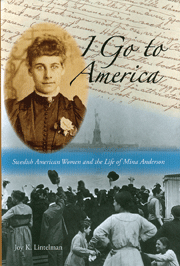
In a book published by the Minnesota Historical Society, "I Go To America," however, author Joy K. Lintelman posits that Swedish women arriving in Minnesota in the late 1880s wouldn't recognize Kristina. These women worked in wage-earning professions and embraced going to America as a life-affirming opportunity.
Mina Anderson, the subject of Lintelman's book, "I Go To America" corresponded extensively with Vilhelm Moberg and she shared with him journals she made of her own life experiences.
The author of "I Go To America" uses this connection as a jumping-off point, wondering why more of Mina's spirit wasn't allowed to come through in Kristina?
Author Lintelman felt Mina's voice has been noticeably absent in literature and particularly ignored by Moberg. This is a book that allows Mina to be heard. Appropriately the Historical Society announces its release in March-- Women's History Month.
Lintelman dedicates the book to Swedish American women and to the life of Anderson. She states in her book introduction, "It is not surprising that when the topic of Swedish immigrant women arises it is the image of the isolated pioneer farmwife that comes to mind."
After researching actual writings of Mina Anderson, and in general delving into Swedish womens' contributions, Lintelman spreads the word that Swedish settler women were anything but isolated and dependent.
Lintelman adds, "Although Mina and other Swedish immigrant women experienced some ambivalence about accepting certain elements of modern American society, given the opportunity many of these women would probably have written-- as did Mina--"I have never regretted leaving Sweden. I got a better life here from the start."
The real fun in reading this book are the pages filled with Mina's writings. Mina, (say meen ah) was born in 1867. The first chapter is first-person relating about her childhood in Dalsland, Sweden.
She adopted the name Minnie later in America, and continued to write frequently and simply throughout her 80-plus years. What amounts to Anderson's memoir is "I Go To America."
Anderson found time in the 1940s to write to Vilhelm Moberg in detail, about her life in Minnesota, and according to Mina's daughter, Lintelman says this was something she ended up regretting. The first two of Moberg's novels, published in the late 1940's, The Emigrants and Unto a Good Land did not please Mina.
Moberg's Kristina character lacked facility in speaking English, and her fictional "...inability to ever feel at-home in America belied Mina's experience," Lintelman states.
*******
A professor of history at Concordia College, in Moorhead and a Fulbright scholar-- Lintelman has lived and traveled in Sweden.
Whichever side of the Kristina aisle you opt to sit on, this book is a very interesting read and contains many cool old photos, graphics and maps.




Comments:
Commenting has been disabled for this item.