May 21, 2009 at 7:51 a.m.
Lyme Support Group takes over trail for one day
Pain, frustration, desire to spread education bring group members together
Pain, frustration, desire to spread education bring group members together
When it came, the diagnosis brought relief of finally knowing there was a name for what they have, yet also brought the anxiety of not quite knowing how the disease would continue to affect them, and how to cope with it in their daily lives.
Myre was originally infected in 1984. She thought the bullseye rash she had was a symptom of the flu, but was eventually diagnosed with Lyme Disease. At the time, she believed antibiotics would take care of it. Unfortunately, antibiotics had come several months after she was unknowingly bitten by a tick, and she later found out the Lyme Disease was still there.
In 2004, she started missing work because she was so sick. Myre had no idea it could still be Lyme Disease.
"I was diagnosed with arthritis and bursitis," Myre said. "They thought I had plantar fasciitis too."
Myre said different pains would come and go, and doctors couldn't pinpoint the cause. Along with it, mental problems, depression, anxiety and insomnia - all common in people with Lyme Disease.
"I functioned with it, but I always had odd ailments off and on. Something would knock me down, I'd get back up and then it would be something else," Myre said.
She was thankful to finally have a name to give to all of the symptoms she was experiencing.
"It was an act of God when I found out five years ago it was still there," Myre said.
She tells of a friend who was going to take a leave of absence from her job because of all the symptoms she had been experiencing that were leaving her physically and mentally drained. Myre urged the friend to be tested for Lyme Disease.
Soon after the 2004 diagnosis, Myre learned a lot about the disease, its symptoms and treatment, but it didn't satisfy her to stop there.
"I felt very strong about helping others with this," she said.
After searching for Lyme Disease support groups, she realized there weren't any groups established in this area. So four years ago, Myre opened the first Minnesota Lyme Action Support Group meeting with a handful of attendees. The group still meets monthly at the same church where it started - Hosana Lutheran Church in Forest Lake - but now there are more than 300 group members.
It was through the support group that Myre met Laura Hamer, of Stacy. The two now serve on the board of directors for the support group, along with Jill Kuschel, of Chisago City, and Traci VanElseberg, of North Branch.
Hamer, who is a nurse, also suffered from various physical and mental symptoms that were misdiagnosed.
"The doctors thought I had ALS or plantar fasciitis," Hamer said. "I was diagnosed with MS (multiple sclerosis) and sent home."
In 2004, she was losing muscle control in one foot, causing it to drop. Doctors scheduled her for an MRI and CAT scans to check for brain tumors.
"There were a lot of painful tests," Hamer said.
What she describes as a fluke interaction led to Hamer's diagnosis. She was put on an antibiotic for her foot, and was telling someone at a party about it.
"She thought I might have Lyme Disease, and told me about the support group," Hamer said.
Hamer went to the next support group meeting, but didn't stay to talk with anyone.
"I walked in, read a poster listing the symptoms, started crying and left," Hamer said. "I just knew it was what I had."
Hamer and Myre have both been given different antibiotics to treat their individual symptoms of Lyme Disease. They live with the reality that if the disease would have been detected early on, it would have been easily treated.
If Lyme Disease is detected quickly, it is successfully treated in most people within a few weeks by taking antibiotics. Unfortunately, the tell-tale bullseye rash and flu-like symptoms do not occur in everyone infected with Lyme Disease. In some cases, symptoms don't manifest themselves for months or years down the road.
Along with the symptoms experienced by Myre and Hamer, the list includes memory loss, heart palpitations, vision trouble, headaches, fatigue, lockjaw and meningitis, among others
There is no definitive list of symptoms because, while Lyme Disease starts in the blood stream, it eventually can move to every part of the body and cause a gamut of physical and mental symptoms.
Hamer and Myre said the best they can do is to pay attention to their bodies - both to the symptoms caused by the disease and how to keep it healthy in the first place.
"You learn to keep your immune system up, take vitamins, eat right, get enough sleep," Hamer said.
"Any way you can get your immune system up, really. Many of us look to alternative medicine to get a boost," Myre added. "But still, I'm always the first person sick and the last person to get better."
"You do get a little phobic about getting sick," Hamer said.
Myre said living with the disease has been a challenge, but she has also enjoyed the good that has come from it.
"I've found this as a journey, and to listen to your body and take care of it," Myre said. "If you're tired, go to bed early. It's a hard concept to do that as a mom and caregiver to others. But I feel very energized having this group. It's good to focus on turning a bad thing into something good."
Myre said the commitments of the group can sometimes be overwhelming, but there are several active members to help shoulder the work.
"We have people attending our meetings from all over - Milaca, LaCrosse, Hudson, the metro area," Myre said. The group's membership includes Myre's 21-year-old daughter, who also has Lyme Disease.
At their monthly meetings, the group hosts regular guest speakers, with a focus on prevention. They have hosted a doctor who believes that for every person diagnosed with Lyme Disease, another 10 who are infected are not diagnosed.
The group hosts a Lyme Disease walk each spring, raising money for education and support.
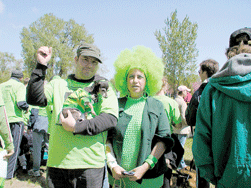
The third annual walk was held last Saturday on the Sunrise Prairie Trail. The walk featured Lyme Disease facts on signs posted along the trail.
Through their own challenges in dealing with Lyme Disease, Myre and Hamer have learned life lessons as well.
"You have to be your own medical advocate," Hamer said. "If one doctor doesn't listen to you, another one will."
They preach prevention to minimize risk, including applying bug repellents with DEET to skin, and permethrin spray to clothing. The common sense approach of wearing long sleeves and pants outside and completing "tick checks" of the body each day are keys to preventing tick bites.
The Minnesota Lyme Action Support Group meets on the second Tuesday of each month, 7 p.m. at Hosana Lutheran in Forest Lake.
More information on Lyme Disease can be found at the Lyme Disease Network: www.lymenet.org, the Lyme Disease Association: www.lymediseaseassociation.org, and the International Lyme Disease Foundation: www.canlyme.com. For more information on the support group, go to its web site: www.mlasg.org.



Comments:
Commenting has been disabled for this item.