November 12, 2009 at 8:58 a.m.
Home health care option fits needs of families
Home health care option fits needs of families
Nelson quickly discovered it was a business she was passionate about, and determined to start a company that would truly care about its clients and their needs.
She quit nursing school and started Accurate Home Care, based in Elk River. Today, Accurate serves 150 clients throughout Minnesota, including 13 in Chisago County.
Their needs are varied, from chronic diseases needing round-the-clock medical care, to people requiring help from a personal care assistant (PCA) with daily care.
"There is no typical client," Nelson said. "We serve every age, every demographic, and every diagnosis."
Accurate provides clients with the level of service they need, whether it's 24-hour care from private duty nurses, or a couple of hours a day with a PCA helping in the home.
The company currently employs 1,000 people, including nurses, PCAs and office staff. None of the nurses or PCAs live with clients; they work a shift and are relieved by another nurse or PCA.
Accurate is successful because of the attention to detail when it comes to placing its employees in a client's home, Nelson said.
New Accurate employees are hired after an extensive interview process and background check. They are also required to complete an orientation and continuing education in their field.
When a new client has contacted Accurate, they then work with the family to match employees with their needs.
Once Accurate staff have decided what level of care is needed, nurses or PCAs are chosen to work with the family.
Before the decision is finalized, however, the nurses or PCAs have a "meet and greet" with the family. Nelson said this step is crucial to ensuring it is a good fit for both sides.
"We're all about client choice here, and we implement that from day one. Even if both sides feel comfortable after the interview, there could be a time down the road when the family says they're not happy with this person, and we'll find someone who is a good fit."
About 75 percent of Accurate's services are paid for through medical assistance, while some services are paid for through private insurance and some families pay a portion out-of-pocket. Nelson said Medicare could be a payment source soon, if legislation changes.
A comprehensive PCA care plan is completed with every family. A list of tasks which the PCA will assist with is completed according to the client's needs and the family's wishes.
Daily activities range from assistance with eating, dressing and bathing to helping with laundry and housekeeping to transportation.
Nelson said the services provided by Accurate's PCAs and nurses allow clients to stay at home.
"It's a better quality of life," she said. "They're getting the same services as a hospital or nursing home, other than the luxury of a doctor or nurse at the press of a button. But that care is at home, and it's far less costly, any day of the week."
One thing hospitals and nursing homes simply can't provide is the one-on-one care Accurate can offer, Nelson said. Accurate's services also go beyond nursing and assisting with daily activities. They have resources to provide grief counseling and help families with mental health needs as well.
"At the end of the day, every person working here truly cares about the clients," Nelson said.
The Walinski family
The Walinskis know more about the advantages of having a PCA in the home than most people. The Isanti family includes three siblings who need comprehensive services and care to deal with complications from fetal alcohol syndrome.
When Michael and Linda first adopted Shawn, Dawn and Richard, the siblings received all their care from their parents.
"We thought we could handle it," Linda said. "We're educated, we have a great marriage, we're strong people, but the challenges of trying to care for them alone were just too much. It brought me to my knees."
The three kids need extensive care, and constant supervision. After a few years of going it alone, Linda called the county public health nurse.
"She asked me what took me so long to call," Linda said.
The Walinskis were introduced to the option of PCAs in their home. About six years ago, they became clients of Accurate Home Care.
Seven PCAs work with the three Walinski kids, assisting with daily needs such as dressing, eating and bathing. They also work with them to teach them basic life skills, so they can become more independent.
All three suffer from brain damage and physical problems related to fetal alcohol syndrome. Dawn, who has cerebral palsy, suffers from seizures, sometimes multiple times a day. She also loves the water, so someone needs to be with her at all times, because if she has a seizure she could drown, Linda said.
Having 24-hour home care prevents injuries, death, and placement in a group home or hospital, Linda said.
"If we didn't have PCAs, we wouldn't have been able to keep our kids."
The kids, in their teens, have poor judgement and motor control. The Walinskis have found them wandering outside in the middle of the night in subzero temperatures, or injuring themselves because of hallucinations.
The Walinskis believe bringing PCAs from Accurate into their home is a cost-savings for more than just their family.
"It is a major cost savings to society, both short and long-term," Linda said. "We have two goals for our kids - keep them alive and keep them out of jail. But it's more than that, it's about humane treatment and keeping people in their home."
She said the alternative would be placing the kids in group homes, or most likely hundreds of hospital stays.
Having assistance from a PCA also brings more independence for the kids, because the PCAs can help reinforce daily life skills, and increasing their social skills, Linda said.
"It's one of the things that brought us to PCAs," Michael said. "Their social opportunities can increase."
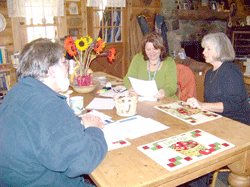
Accurate clients have a case manager assigned to them, who visits the family at least three times a year. The visits are more frequent if the family has a new PCA or is new to Accurate. The case manager works with families, discussing care plans and ways to work to achieve goals for the client.
The Walinski's case manager, Deb VanDonsel, said not all families are as knowledgable about care options as Michael and Linda, so it's crucial to establish a good working relationship with a case manager.
"I'm always on the other end of the phone if they need me," VanDonsel said.



Comments:
Commenting has been disabled for this item.