November 11, 2010 at 8:46 a.m.
In uniform and after; she threw herself behind the cause
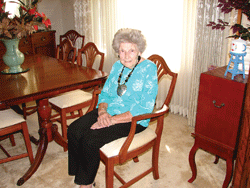
In uniform and after; she threw herself behind the cause
"I didn't do anything special," Dorothe maintains when asked to do an interview; yet that's not entirely true. For one thing, being in the Navy in 1943 was actually quite ground-breaking. President Roosevelt had only signed authorization allowing women in the Navy in July 1942.
Less than a year later Stream belonged to the WAVES. The term stands for Women Accepted for Volunteer Emergency Services, by-the-way, and it has nothing to do with water or the ocean.
Not all service personnel stride into war standing tall, some serve as a last resort. Some come out the other side of the experience with a vastly improved outlook, some are shattered. Stream's story is somewhere in the middle. She said in the service you learned: love your country, do a good job, learn to respect others, be a productive citizen afterwards. The medals and drama were few and far between.
Stream remembers her mother as the reason she enlisted.
As she grew up in Waterbury, Connecticut, a town dependent on the defense-industry, Dorothe's mother was concerned it would be at the top of an enemy hit list, and as odd as it sounds, she insisted her daughter would be safer if she enlisted. Dorothe graduated from high school in 1938 and within four years she was aboard a miserably hot passenger train, being sent by the Navy to attend school (radio code oscillator) at Madison, Wisconsin.
After school Dorothe was assigned to the radio room at NAS Anacosta, on the Potomac River in D.C. She lived in barracks there. The facility housed an executive airport and one of the perks was that Stream saw the likes of Winston Churchill and Madame Chaing Kai-shek coming through on state visits. Also; the airport was where seized Japanese Zero airplanes would be dis-assembled and studied. They were state-of-the-art back then. Dorothe had an interest in everything, and she'd make time to view experimental flights or observe plane assembly at the airport.
Stream recalls, "I don't know how those guys did it, flying those planes back then. The inside was all wires and metal and bare bones."
Stream was in her impressionable 20s. Moments from this time of her life are with her still. Imagine watching Gene Kelly kill a little spare time, dancing at the airport. She met movie idol Tyrone Power. The airport was where "all the Hollywood types" and dignitaries eventually came through, she says.
Dorothe remembers the sensation against her legs of a nasty opaque stocking material the Navy required as part of the uniform. She couldn't wear jewelry or nail polish, hairdos had to be collar length or shorter. (Although recruiting poster art depicted WAVES looking like starlets.)
The posting outside of D.C. expired and she was next assigned to Solomon Island, off Maryland, on the Puxatant River. Here they did mine testing-- detonating samples of newly-manufactured mines before sending the shipment to a Navy base. Dorothe handled radio communications with the submarines. She traveled around to various east coast facilities and remembers flying over The Pentagon while it was under construction.
She was working "the radio shack" the day FDR died.
Dorothe calls the Navy an extremely positive experience. "Lots of gals served" and she was always treated well and had no problems. She met her husband, Lyle, in the Navy.
She was discharged around late 1945-46 and Lyle was cut loose in 1947. They returned to Lyle's hometown, Lindstrom, in 1952.
Dorothe and Lyle had three children: Lyle jr who lives in Florida and daughters Laurie and Linda who still live in Minnesota.
Dorothe worked for the old State Highway Department (now MnDOT) in road design and retired after 35 years. Lyle died years ago, but Dorothe still lives in the home they bought, right next door to the house Lyle grew up in.
Stream had a need to give back to veterans, an itch she couldn't ignore after the war. Decades of contributions to this nation and to fellow veterans ensued.
At less than five-feet-tall, she cuts a familiar figure at many local veterans' events. Commemorative programs at the All County Veterans Memorial and area cemeteries wouldn't be the same without the diminutive Dorothe in uniform. She stands right alongside the local men veterans, a reminder of all who served. You'll see Dorothe placing the wreath at the memorial wall. There's Dorothe selling the VFW crepe paper red poppies.
She serves on the all county veterans memorial site committee. She lends a hand at Boys and Girls County (dedicated to civics and government) held at the Center City government center.
Stream has held offices such as President of American Legion Auxiliary Post 83, was commander at Legion Post 155 in St Paul when she worked downtown, is still a member of the National Organization of WAVES and was President of former Lindstrom VFW Auxiliary Post 7267.
Dorothe shares that she is concerned the United States is losing its ability to manufacture things.
She says, "American initiative got us through the war." World War II could have just as easily gone the other way, without the innovation of American workers and ability to produce from raw goods. She wonders if America has forgotten this.
Dorothe is also concerned about the patriotic organizations which have added so much to her life. She sees the need for attracting membership, but younger veterans don't seem interested in joining. They are "a different bunch," she remarks.
At 90 she wonders what the future holds. Just like the Victorian era house she maintains, these organizations ought not to be neglected. In her neighborhood, the houses along her street make a unique community. One was recently torn down and now she notes, gazing thorough the window sheers in the front room, there's just an empty lot.



Comments:
Commenting has been disabled for this item.