March 17, 2011 at 8:15 a.m.
Rush Lake gets another shot of iron in association effort toward healthy lake
Rush Lake gets another shot of iron in association effort toward healthy lake
Association spokesperson David Cartwright said the association is going to spread additional iron filings into the lake in spring-- by boat-- once open water returns.
Blue Water Science, a Twin Cities company that consults on lake/marine water quality and improvement practices, has been working with the RLIA.
Limnologist Steve McComas said the open water application will be instrumental in developing another option for applying iron filings.
McComas said iron itself is several times more dense than water and settles on the lakebed, where it is supposed to go. Once in the sediment the iron binds with phosphorus, restricting its availability as a nutrient promoting weed growth. Using iron filings is efficient as there is no "waste rock" being added to the lake ecosystem. Unlike other iron mineral products, iron filings have no powdery material (fines) associated with their use which would affect lake clarity. The filings are from foundries and almost 100 percent iron.
The Rush Lake Improvement Association in 2009 placed iron filings into the lake much the same way as was done a couple weeks go. Volunteers cut holes and helped direct filings through holes, concentrating a couple weeks ago on three test areas of approximately one acre a piece.
The RLIA learned from the application almost two years ago, according to Cartwright, that using holes in the ice tended to concentrate the filings in a pile as they dropped to the lake bottom.
By depositing filings into open water, the association hopes to see better dispersal. By using both approaches they can be compared.
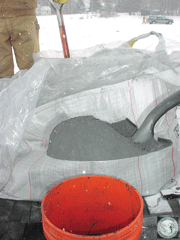
The iron filings are about the size of a grain of table salt. (See photo.)
The association will measure the effectiveness of the filings in reducing Rush Lake's curly leaf pondweed problem. Researchers continue to increase their understanding of the chemical reactions occurring in lake sediment; along with identifying any impacts the filings might have on species or habitat.
It is widely reported that iron is superior to alum-- which has also been used (not in this county) to reduce weed growth.
The county commissioners were advised that the issue with aluminum sulfate is its limited success. One study done in 2005 shared by the RLIA while meeting with the County Board, is that "higher sulfate concentrations are viewed as increasing the magnitude of phosphorus released from bottom sediments." This is the opposite of what's desired.
Applying alum also introduces sulfur into the lake sediment, plus it is relatively expensive.
Cartwright told the commissioners the association continues to research and apply iron filings, because, "We have strong reason to believe it will be successful."
The commissioners were told the association has also made efforts to limit external sources like manure, farm fertilizer, etc. that are sources of phosphorus entering Rush Lake.
Late this summer divers will count plant growth (stems) from the bottom of the lake, using a grid system, and researchers evaluate the before and after tallies.
FYI....
Rush Lake and Rush Creek are on the list of impaired waters through the Federal Clean Water Act and Rush Lake is "eutrophic."
The lake improvement association is self-supporting and does not receive any tax dollars.
The association members (rlia.org) meet the third Saturday of each month, next meeting will be Saturday, at Nessel Township Hall, at approximately 8 a.m.


Comments:
Commenting has been disabled for this item.