April 16, 2015 at 3:58 p.m.
Two, of a dozen-plus historic county mills, remain
Two, of a dozen-plus historic county mills, remain
Next time you crack open a fresh cool bag of flour take a second to consider how the grain milling industry has contributed to making Minnesota what it is today.
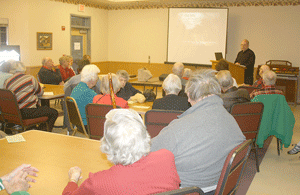
An industrial historian, speaking at the North Branch Senior center last week, had a rapt audience of 50 people enjoying his presentation on the many grain mills operating in Chisago County from the mid-1800s to early 1900s.
The program was a cooperative educational forum sponsored by County Historical Society and the North Chisago County Historical Society (Rush City) membership.
Presenter Robert Frame first dug into the history of mills when he was consigned over 30 years ago, to do an 18-month study of flour milling and grain elevators for the state historical society. He is also an expert in other areas of historical industrial applications and equipment.
At one time there were 1,000 mill locations documented in Minnesota.
Local farmers could take their grain to one of 15 mills in Chisago County alone, churning out feed and flour/grain products here.
They could get a custom milling service or they could sell the grain outright to the mill to be processed for more commercial style use. Some had sawmills operating in conjunction on-site.
Only two active milling operations remain in this county-- Ardent in Rush City and Peterson’s in North Branch.
Frame told his audience how those old time historic mills were processing local crops and not widely transporting much product out or in. Names associated with the mills echo the surnames of many historic families in this area.
Mills in Kost, Center City, Lindstrom, Taylors Falls, Franconia, North Branch, Harris and Rush City would have looked quite different from what most people envision when they think of a mill and the ubiquitous waterwheel attached to an idyllic streamside presence.
Mills in Chisago County, and indeed all throughout Minnesota, did not use waterwheels for power, Frame explained.
The Rush City facility was electric; six other county mills relied on turbine water power and eight mills ran on steam power.
Frame described how the use of turbines (basically a pinwheel that turns on a drum, and transfers power to a shaft) became the preferred source of power in Minnesota. (Kost Dam County Park still has a mill turbine on site)
Frame said turbine power proffered a host of benefits over wooden waterwheel technology. The metal turbine was manufactured to exact specifications at plants that were making these units in quantity. A turbine required less specialized maintenance, and a turbine took up less space. Turbines sported a more “modernized” aura versus the old wood waterwheels.
There’s one historic mill in the Winona MN area, “Pickwick” that has a wheel, but it was rebuilt after the more recent owners took out the turbine power unit, which was put in to replace the first waterwheel, Frame said.
Other great Minnesota historic mills are in Ottertail County (The Phelps Mill) and he said Sheck’s Mill in Houston County is “the best.”
Minnesota was the “center of the universe” for milling, Frame continued. Think Pillsbury and General Mills.
The state became famous for its “patent flour” which was the result of innovations directed towards creating the perfect white, high gluten flour that consumers wanted for baking.
A “middlings purifier” unit was patented in about 1871 and Minnesota engineers were the brains in developing what was basically a groundbreaking “sifting machine” that removed the unwanted grain middlings turning flour a darker color, etc.
Millstones that ground grain through brute force of rotating weight, went by the wayside as “roller mills” became the new standard. (And, according to Jerry Peterson, the North Branch Mill utilizes the next generation process; hammers.)
We spoke briefly with Peterson after the historical society event. He has over 50 years working at the business that his father Burt acquired in 1956. The North Branch operation no longer mills for human consumption. North Branch handles ag feed, corn and soybeans mostly, and a little oats and rye, he said. Wheat wasn’t ever a local grain of any note, he commented.
Peterson said there’s a piece of historic equipment from the North Branch Mill on display at the College of the Ozarks museum of milling, near Branson, MO if you are ever in that neighborhood.
Frame found a huge reservoir of information in the Sanborn Fire Insurance Company Maps. He said the Hennepin County Library system and state History Center have this information available (originals are in color at the St. Paul center) The detail is surprising and accurate. Mill company asset locations, equipment inventory, and facility square footage and improvements were all kept track of.
The railroad of course, had a massive impact on the smaller mills and gradually they became defunct. Grain elevators came into use along rail routes and now mass quantities of crop could be stored for farmers and transported.
People could compare quality of flour, and opted for superior products.
Frame said the Pillsbury “A” mill in Minneapolis churned out a thousand-times what small mills were capable of. Rush City; a large facility for Chisago County, reported in the 1930s census it was at 900 barrels per day. (A half-barrel then was 98 pounds.)
Census archives are known for family research but they are invaluable for employee/business research as well, Frame added. And, General Mills archives (as well as Pillsbury’s before it was acquired) can be accessed if you call and make an appointment.
+++++++
The North County Historical Society is hosting an Open House at its new museum building (across from city hall) at 350 Eliot in Rush City, Saturday, May 9. The museum opens at 9 a.m., closing about 4 p.m.
The Chisago County Historical Society holds its annual non-profit organization meeting at 10 a.m. and provides a show of the public’s collections, at noon, Saturday May 16, at Amador Township Hall.
Watch for details here in the Press or go to the website if you are interested in sharing an historic collection.

Comments:
Commenting has been disabled for this item.