July 9, 2015 at 1:05 p.m.
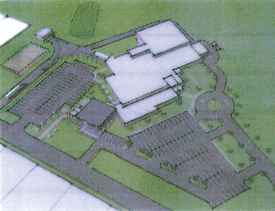
Jail design expenditure authorized 4-1
Jail design expenditure authorized 4-1
During the Board meeting open microphone was used by about six citizens who wanted to address this.
There were some who argued for the “do nothing” approach; either because they are concerned about the county’s debt or they don’t like the state imposing incarceration standards, or they just don’t see the need.
Others said don’t tackle any of the estimated $2 million in deferred maintenance needs at the jail now and bulldoze it. Transport all the arrestees in the county to other facilities.
Then, there was the contingent that looks forward to when the jail provides a secure work environment; complete with programming space for education, including chemical dependency counseling and more. This contingent sees a new jail as the springboard towards a model rehabilitation program.
There were also the compromise proponents. Those who argued for downsizing the project now hovering around $24 million.
All of these viewpoints took-up surprisingly little time at the meeting July 1 which many guessed would run for hours.
Commissioner Walker, who was the no vote, created a powerpoint style presentation on her alternative no-project plan, she titled “A Bold Approach.”
Commissioner Walker remarked that she’s heard fellow commissioners say at prior meetings that if she had a plan everybody would love to see it. So, when three project options were put on the table; there was a heated exchange between Chair Rick Greene, and Walker, as she asked to be allowed to use the powerpoint (audio-visual) equipment to show her “Option Four” and was denied permission.
There was a five minute recess as Walker had her powerpoint copied onto paper for the audience to follow along.
Board Chair Greene explained he preferred Walker first present her concept to the jail subcommittee, where her data and conclusions would be reviewed and substantiated. Walker maintained that Greene knew she wanted to present at the Board meeting and called him a liar.
Commissioner Walker’s option calls for the existing jail to be demolished and inmates transported to facilities where the county would have “host contracts” for room and board. She said rates can be negotiated at $55 per day per inmate, based on talks she’s had with other counties.
Walker contrasted this to the county’s estimates of daily board-out jail costs of $100. The “savings,” she calculated, would make up for the increased expenses in transportation budget.
She said no jobs would be affected because “jailers” are also defined as “transporters” in their employment agreement.
County Administrator Bruce Messelt pointed out her data was missing some costly multipliers, and there’s no additional transport costs for hauling all inmates to multiple court appearances-- as inmates now travel about two blocks to a courtroom. Likewise-- no mention of mileage and hourly costs to taxpayers of municipal police departments, lacking access to a jail in Center City, was made.
Commissioner Walker noted seven counties don’t own jails, so if Chisago eliminated the building, the upkeep and liabilities disappear, another savings, she said, and this would be nothing new.
Commissioner Mike Robinson rejected that comparison. He declared that all seven jail-less counties combined, don’t have the population Chisago County has.
Robinson also said jail cell occupancy statistics cited by Walker are being overly simplified and are out of context. Bed space/jail capacity isn’t as simple as putting inmates into empty beds. County beds are un-filled because certain inmate classifications or male-female offenders can’t share space. The county has to board these people elsewhere even though one of the 67 county beds may be technically “empty.”
Commissioner George McMahon observed that the 4-1 vote only sets the stage and declares the county’s intentions. He said the MN Department of Corrections promises looming sanctions without movement on a project, in limbo for years. Plus, budgetary details and physical plans for a project will be needed if the county wants cost-share funding from the legislature.
Commissioner McMahon added, “There’s time to do things yet (analyze Walker’s proposal)....I support the motion...we need to move forward and take the politics out of this.”
Commissioner Ben Montzka, who made the motion to advance the subcommittee and staff’s preferred option, acknowledged he had earlier been opposed to a jail project, but he’s convinced a “decision needs to be made.”
He explained that Walker’s option was based on selective factors and that a number of “relevant” issues were missed in her assessment. The “law enforcement center” also includes office space for sheriff’s administration and opens square footage at the Government Center for future growth there.
Montzka asked Messelt when the jail subcommittee might be able to look more deeply into Walker’s statistics and projections and report back. Messelt said he will schedule a committee meeting as soon as practical.
The options given to the Board were:
The adopted Option 1...proceed with bid documents and plans for 120 bed facility.
Option 2 was gut the old jail and renovate to remain a Class III jail.
Option 3 repairs and rehab for old jail to be used for only 90 day hold. Create a management plan for population not housed.
Options 2 and 3 also required further review of impacts to the 2016 budget. Option 1 has money set aside in a line item dedicated to the project.
During the Board meeting Sheriff Rick Duncan expressed his support for the Option 1 project. He was accompanied by his chief deputy and the jail administrator. They stepped down and observed from the audience area as Option 4 was being presented and didn’t comment.
Sheriff Duncan said he can look over Walker’s option, which nobody had seen prior to the Board meeting, in subcommittee.


Comments:
Commenting has been disabled for this item.