October 15, 2015 at 1:59 p.m.
Over 100 attend October 7 hearing on solar project
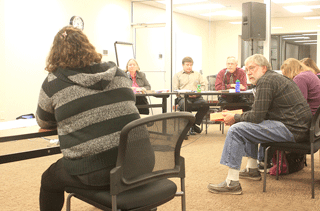
Over 100 attend October 7 hearing on solar project
The applicant-- North Star Solar PV LLC-- hopes to erect several hundred acres of solar array equipment, in the general vicinity north of the Lent Township substation.
The site covers a portion of Sunrise and Lent Townships and rural North Branch. The 800-acre array complex itself will connect to the nearby substation using under-a-mile of new high voltage transmission line. The two project requests are combined by the Public Utilities Commission into one permit.
North Star spokesperson Chase Whitney said the company and Xcel have a 25-year power purchase contract in place.
What is misunderstood about this application, that regulators tried to make clear, is that it is NOT part of a state legislative mandate promoting sustainable and renewable energy in Minnesota. The mandate gave Xcel a certain number of years to achieve a certain percentage (1.5) of retail energy sales through “alternative” power resources like wind and solar.
Xcel is a distribution entity and doesn’t physically generate the power.
This local project was analyzed by the Public Utilities Commission in the context of stabilizing energy rates and de-celerating future increases in a rate-setting agreement. Xcel took RFPs for 110 different projects before determining the final few, including this one in Chisago County, that presented the best options.
The legal counsel for Community Energy Renewables LLC, Eric Swanson, told the audience that Xcel made the case with the state for this solar project being “in the best interests of rate payers,” North Star was established in 1999, Whitney continued, and for background he showed slides of three existing North Star solar facilities in Virginia, Georgia and Colorado.
A question about lobbying and expenditures attributed to a “North Star Transmission” enterprise at the state capitol was met with a firm denial that the solar company has a similar name but is not related to this.
This project is calculated to have the capacity to generate enough electric power to service 20,000 homes annually.
In response to many questions about why here- in Chisago County-- Whitney said the location was chosen for having land that is considered “not prime” cropland soils. Minnesota doesn’t allow prime farmland to be tied-up in energy creation.
Whitney also said the parcels are owned by willing participants who cooperated with North Star when approached about the project. Three homesteads were bought out that lay within the solar array footprint.
Also the fact that there’s a major substation nearby and a corridor of High Voltage Lines already exists, was a major consideration. The connection into the regional electric grid is most cost-effective when the source of energy is as close to the substation as possible.
From testimony last week, it was obvious that property owners on the perimeter of the project are most upset.
The MN Department of Commerce and the Public Utilities Commission have drafted an environmental assessment for the project, which many meeting attendees had reviewed on-line and were able to question actual language contained in the draft.
The process is at the stage where officials are gathering local comment on what specifically to include in a site permit-- if one is approved by the PUC Board.
This permit comment period closes October 21. (See sidebar box on how to submit comment.)
The PUC Board is tentatively scheduled to have the permit for action on a January 2016 agenda. North Star filed the permit in February 2015.
Everybody had their say (sometimes redundant), allowed by a very patient Judge Case.
PUC project analyst Scott Eck explained a number of times, that this permit met legal criteria as a complete application and the PUC has no option but to process it. Eck said, The PUC “...can’t just say we don’t want to take a look at your application.”
He responded to several comments by those who stated this solar power generation site “isn’t needed” explaining there is no certificate of need for this project. He added, the “whole idea of (this hearing) is to learn about the site.”
Highlights of the extensive permit concerns that were expressed include:
~ Fencing. North Star has revised the original chainlink style to a “deer fence” style, more like what is used in agricultural and natural settings. Wood post uprights and wider-guage wire mesh are proposed now.
~ Lighting. There will be lights on access gates when staff need to be at the site. Otherwise North Star officials assured the citizens there’s no need to light the facility.
~ Noise from movement of tracking mechanisms. The panels follow the sun’s angle and tilt on slide bearings that a company technology associate described as “barely audible.”
~ Dust control. The agricultural crop operations historically here were creating more dust than this project. Where crop growth was beneficial maybe four months, the project site will be undisturbed year-round. Site vegetation plantings (beneath the panel supports) are being coordinated with Department of Natural Resources specialists.
Additionally, traffic dust during construction will be controlled. Construction takes six to nine months, according to Chase Whitney.
A beekeeper alliance spokeserson, Marcie Forsberg, applauded the native plantings proposed for this site as providing habitat to pollinators, a stressed category of species. Also Rob Davis remarked that 800 acres of wild grasses and flowers is tantamount to 150,000 private homeowners planting a 12 by 12 garden of pollinator-friendly vegetation. He offered, “The benefits pop right out at someone who cares about conservation.”
~ Tax revenue and local benefit.
Officials explained that the “production tax” under Minnesota law is based on actual power production, so it’s estimated at this time as a couple hundred thousand dollars. ($1.20 per megawatt hour.) And, most of the site is generating limited revenue now as ag land and goes to commercial, which hikes the tax formula, and brings this closer to $350,000, divided among county-local and school district.
~ Health impacts. A lengthy argument about electro energy straying from the solar equipment and impacting animals and nearby residents ensued.
State regulators responsible for the draft environmental review explained that data and studies on EMF and its effects are available, but were not applicable to the solar power production here.
Dept. of Commerce official David Birkholz said dirty energy is a phenomenom that occurs from the substation-out in transmission. It was noted that there have been High Voltage Lines existing in this general neighborhood for many years. Concerns being expressed are ones that researchers continue to study-- but aren’t associated with this project.
~ Property value and marketability. The solar industry is relatively new and its direct impact on property value hasn’t been quantified without the ability to analyze years of trends and actual sales. Birkholz said the permit is trying to “diminish negative impacts” such as requiring using screening around the site with trees, leaving standing windbreaks and treelines in tact, etc. and having setbacks for distance between dwellings and the project. Setback from parcel lines is now 50 feet for the array equipment. Some people whose homes are situated close to their property line asked if this can be increased.
One neighbor, Linda Rooney, expressed how she “...had a lot of questions” when first learning of the project; then came to realize that there won’t be farm equipment operating on the fields, or herbicides and pesticides being applied, or unprotected soil blowing around. She said she also likes the certainty that there will be solar panels there for years. Her conclusion is the project is an improvement over what’s been there.
On the other side, as Fred and Tina Carey stated, this project is “...too much of an impact and it’s just not right.”


Comments:
Commenting has been disabled for this item.