October 9, 2026 at 10:44 a.m.
District holds 2026 get-together
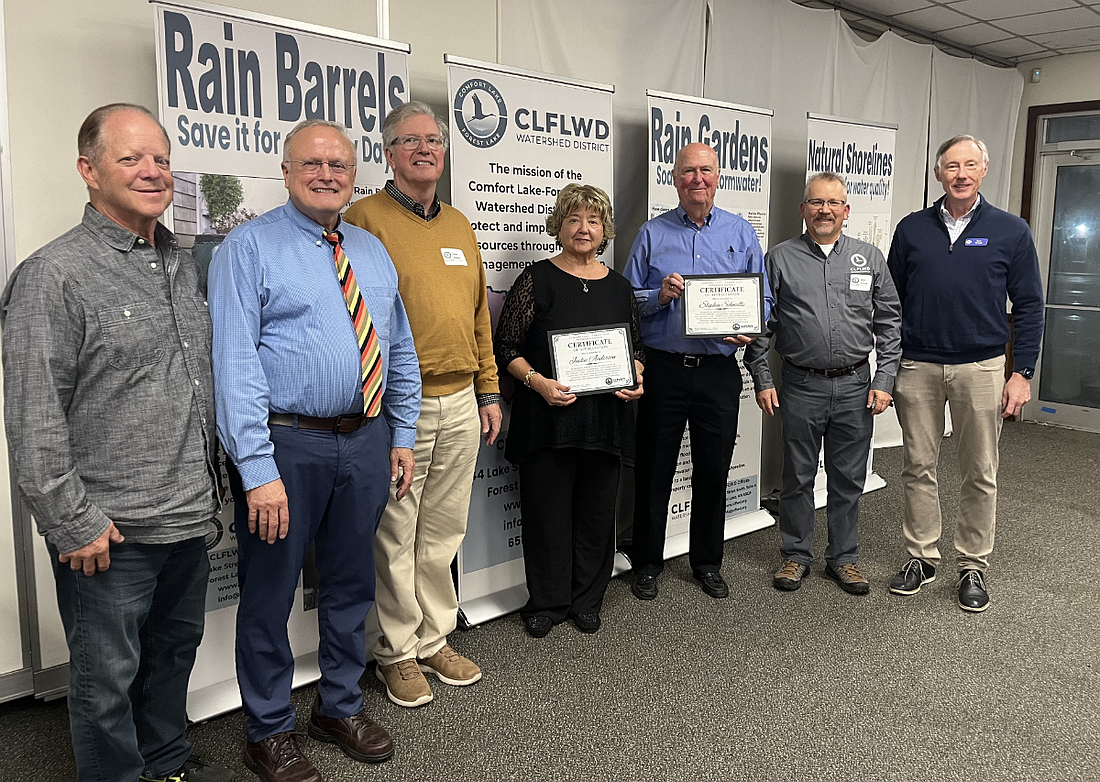
Two longtime watershed district managers were celebrated last week at the annual district public dinner as their terms ended, Jackie Anderson representing Comfort Lake and Steve Schmaltz, for Forest Lake. Ted Hansen was appointed by Chisago county commissioners to succeed Anderson and Blake Roberts succeeds Schmaltz. Chisago County Commissioner Ben Montzka, pictured second from left, said he often relied on Anderson over the years for background and advice when he was being asked to make a decision. He said she advocated to create the watershed district to tackle issues that were not being resolved— and has contributed “thoughtful vision” and worked tirelessly over years of public service.
The annual Comfort Lake-Forest Lake Watershed District public information meeting and dinner always promises to be a learning opportunity as the district staff and appointed board managers interact with the public —and last week was no exception. Event-goers who filled the Forest Lake American Legion Post banquet room, seemed to want to talk about Forest Lake weed harvester activity— which derailed discussion briefly about watershed district activity, but sparked some interesting voices on both sides of the efficacy of harvesting weeds.
The CL-FL watershed district as an agency does not fund weed cutting and has zero involvement in harvesting. This is strictly a Forest Lake Lake Association (FLLA) and municipal program.
Whether you are a believer that the only good lake weed is a dead lake weed, or you see the benefits of having a robust aquatic plant habitat in your part of Forest Lake, direct your complaints or suggestions to the city council and lake association members.
Consider as well, that you can be part of the reduction of nuisance lake weeds in general if you get a soil test for your lawn area. Blayne Eineichner and Adam Hjelm, staff members, explained there are mini-grants for upkeep of natural shorelines if yours is getting overgrown or not functioning correctly. There is also a soil test service the staff can provide. There are two main benefits to having a healthy lawn with deep root systems: the rainfall is retained and takes up, lessening the need for fertilizer and the water that soaks through slowly (instead of hard packed soils) gets too cool before entering the ecosystem, which better regulates lake temperatures.
Hjelm added the outreach classes and program schedules for both the Chisago and Washington county locations are listed on-line.
Executive Director Mike Kinney said the idea is to work from the science behind good water quality. The district’s approach using sequential diagnostic assessment, (science and data focused) is being given a good look at the state level, as an example of success in achieving water quality.
Kinney pointed out the goals that the managers embraced aiming for 2040 and beyond, are being accomplished now. A citizen asked about debt and the practice of taking on loans for water quality projects, which will not be retired for several years still.
Kinney said positive results from doing projects before their costs inflate over time, is measureable. For example, the district successfully worked on Shields Lake cleanup. The stormwater and adjacent golf course turf chemicals were killing this small lake and through a comprehensive stormwater management system, plus a holding area for clean run-off which is now used for watering the course, there’s improvements in water quality, plus 27 million gallons of irrigation needs are met annually without draining the groundwater supplies.
Kinney said this region is “overconsuming” our aquifer reserves, so this one project should be viewed in terms of “how valuable do you think freshwater is,” he stated.
The district fundamentally pursues “nature based solutions” as much as possible, Kinney continued. The objective is to avoid projects that rely on engines or mechanical devices which break down and need replacement.
The proposed budget and levy for the watershed district, which is shared between Chisago and Washington counties, is at a 4.8 percent increase from current.
The projection is for a local levy to collect $2,341,052 for next year. The full expenses are estimated for $3,293,657. The difference comes to the district through funding from state and federal programs, grants and permits, contributions and interest revenues.
The taxation public hearing is December 17 at WD offices. The budget adopted up until now can be reduced but by state law can not be increased, with the final action on next year’s budget and levy needed in December.


Comments:
Commenting has been disabled for this item.